LAB SAFETY AND EQUIPMENT TRAINING FOR LAB TECHNICIANS
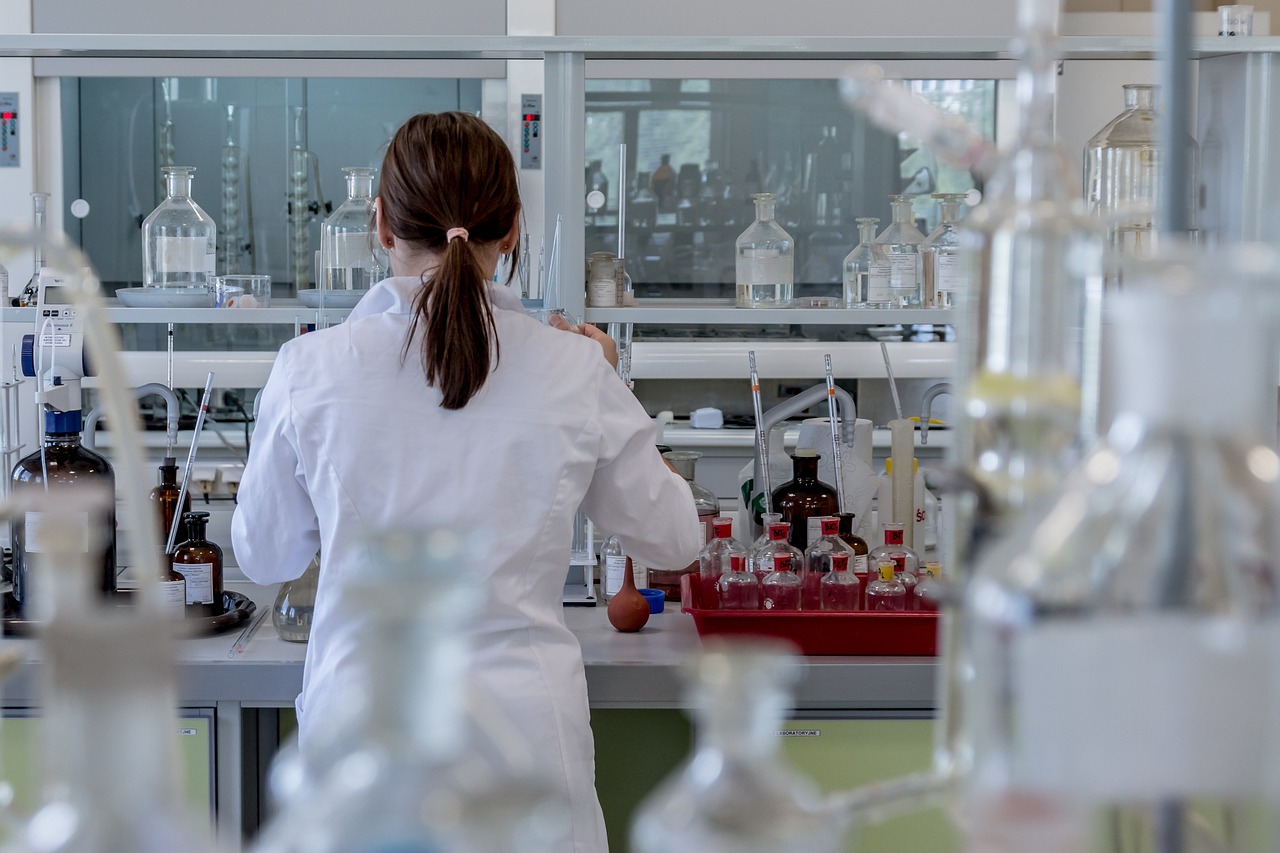
You run the prep room. The chemicals come in through you, get labeled, shelved, counted and dispensed by you, and leave as waste through you. The equipment is set up, checked and sanitized by you before a student touches it. Science Safety’s lab safety and equipment modules are written for that job: each one a short course on one thing you handle every week, with the rule it rests on and the record it leaves behind.
Every module ends in its own certificate. Built to the Science Safety Teaching Standard.

The technician is the safety system
A science department runs on the person nobody sees: the technician who has the inventory straight, the safety data sheets on file, the spill kit stocked, the glassware checked and the hoods running. When a program is inspected, the records asked for are the technician’s. When an accident is reviewed, the setup that is examined is the technician’s.
Most lab safety training is a one-hour video made for every workplace at once. Science Safety treats the technician’s job as the skilled role it is: one module per task, each one specific to a school or college science lab, each one ending in a certificate you can show.
Laboratory Specialists
The module on the job itself: preparing labs for chemistry, physics and earth science, maintaining the balances, burners and glassware, keeping the chemical stock and the records, and knowing where your responsibility ends and the teacher’s begins.
Safety Awareness for Science Laboratory Coordinators
The pathway for the person who runs the prep rooms across a department: the safety issues that cut across every lab, the inspection walk, the culture a coordinator sets, and the records that show a department is in control.

What a lab technician handles, and the module for each
- Chemical inventory: every bottle counted, labeled and on the sheet, with its safety data sheet
- Chemical storage: segregation, ventilation, the flammable cabinet, the locked door
- Spills: which ones you clean, which ones clear the room, and what goes in the waste log
- GHS labels and safety data sheets: reading them, writing them, filing them
- Gloves and protective equipment: matching the glove to the chemical
- Heat sources: burners, hot plates and the burns, scalds and fires they start
- Lab equipment and sanitizing: biology equipment, glassware, disinfecting between classes
- Eyewash and showers: where they are, how they are tested, who logs it

Hazard Communication reaches every bottle you touch.
OSHA’s Hazard Communication Standard, 29 CFR 1910.1200, requires every container of a hazardous chemical to be labeled, every safety data sheet to be on hand for the people who work with it, and those people to be trained. The Laboratory Standard, 29 CFR 1910.1450, requires a written Chemical Hygiene Plan that says who does what. In a school or college science lab, the person both standards are describing is the technician.
Science Safety’s modules teach each of those duties as the technician meets it: the label on the bottle, the sheet in the binder, the spill on the floor, the glove on the hand.
Lab safety and equipment modules for technicians
A note for department chairs and principals
Who this training is for
- Lab Technicians and Laboratory Specialists
- Science Laboratory Coordinators
- Prep Room and Stockroom Staff
- Teaching Assistants who set up and clear labs
- Lab Managers and Technicians in industry
- Department Chairs who supervise the prep room

Ask Yourself
Could you hand an inspector the chemical inventory today, and would it match the shelves?
Is there a safety data sheet on file for every bottle in the stockroom?
Which spills do you clean yourself, and who decided that?
When was the glove chart last checked against the chemicals you actually dispense?
Who tests the eyewash, and where is the log?

Frequently Asked Questions
Both. The rules are the same federal standards, and the modules name them. The examples are set in school and college science labs, where the technician prepares for classes, and they carry over to a research or industrial prep room directly.
Most are a single sitting: a short course on one task, a quiz you pass at 80 percent, and a certificate. The Coordinators pathway is longer because it covers a whole department.
No. Start with the task on your bench this week. Laboratory Specialists is the one that describes the job as a whole, so it is the natural first module.
Yes. Departments and districts enroll teams through a group purchase and can see who has completed what. Use the contact button above and tell us the size of the team.
Every lab safety and equipment module
The full Lab Safety catalog, including the free state compliance modules. Open any module to see its lessons.
9th Grade Science Lab Safety – Reduce Risks
AP Chemistry Safety for Educators
Arizona State Specific Science Safety Compliance
A free module on the Arizona science lab safety rules and requirements, and only those, each tied to its Arizona…
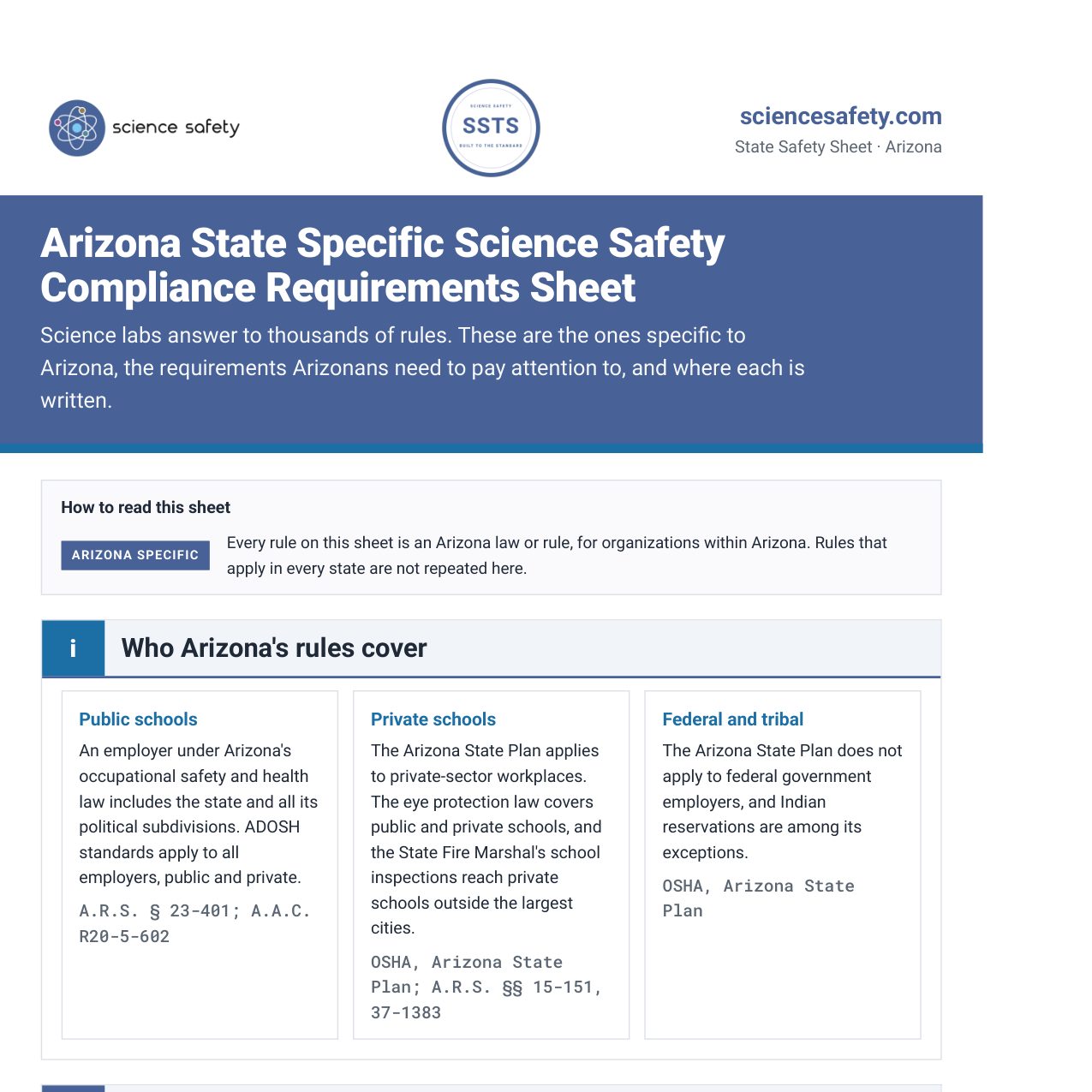
Arizona State Specific Science Safety Compliance Requirements Sheet
The Arizona science lab safety rules and requirements, and only those, each with its exact section, who it covers and…
Basic Science Safety Training for Teachers and Staff
Biology Lab Equipment
C-14 Certificate of Fitness (NYC)
California State Specific Science Safety Compliance
A free module on the California science lab safety rules and requirements, and only those, each tied to its California…
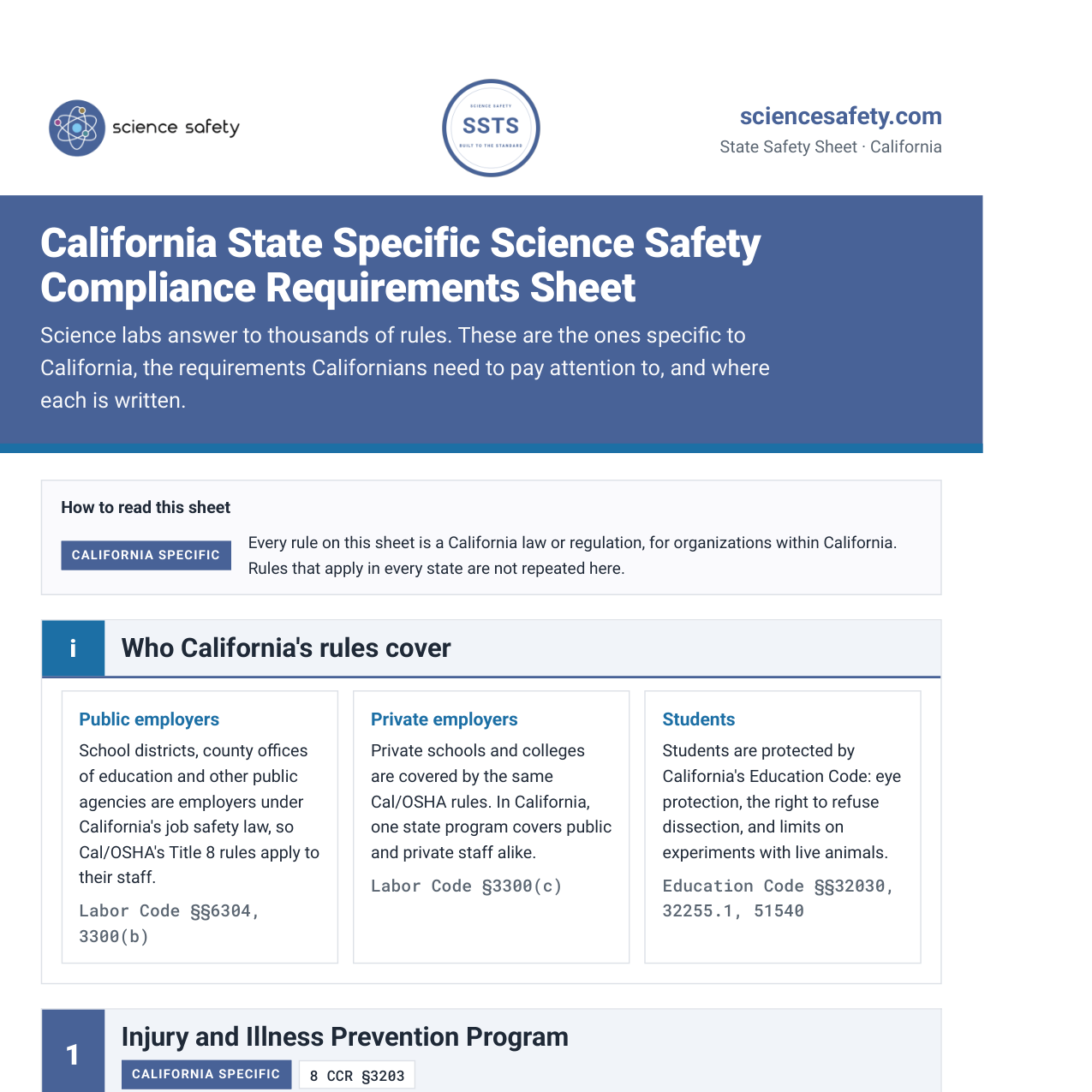
California State Specific Science Safety Compliance Requirements Sheet
The California science lab safety rules and requirements, and only those, each with its exact section, who it covers and…