




A SAFER SCIENCE PROGRAM, DISTRICT-WIDE, FOR SCIENCE SUPERVISORS
You are responsible for science in every building, and for the safety of every teacher and student doing it. A supervisor cannot walk every lab, but a supervisor can make sure every lab is walked, every teacher is trained before the first hazardous lesson, every building keeps a current Chemical Hygiene Plan, and every record exists before anyone asks for it. Science Safety gives district science leaders the training, the references and the group enrollment to run that program across a district and show the board it is working.
The program for the district office, the pathways for every building, and the records for both. Built to the Science Safety Teaching Standard.

One standard for every building, instead of a different habit in each
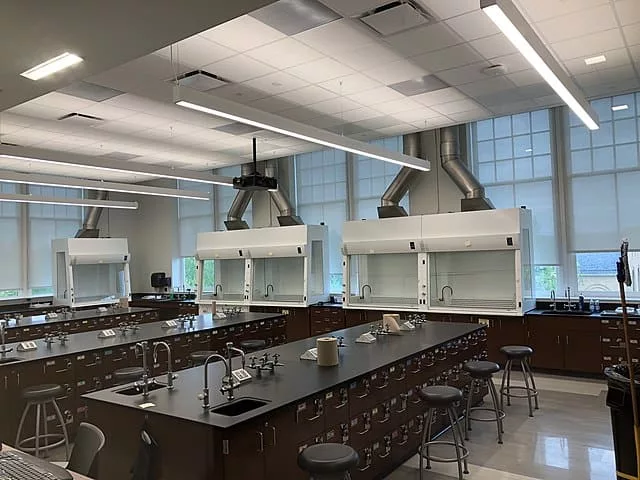
In most districts, science safety is as good as the most careful teacher in each building and no better. One school tests its eyewash stations monthly and another has never flowed them. One department reconciles its chemical inventory every October and another has a storeroom nobody has opened in years. The supervisor is the one person placed to replace that patchwork with one program: the same training for every teacher, the same plan in every building, the same inspection on the same calendar, and one set of records the district can stand behind.
Science Safety is built for that job. The district-level certificate sets up the program, the role pathways train each building’s people, group enrollment puts every completion on one record, and the state compliance sheets name what your own state requires on top of the federal rules.
Chemical Safety Management Certificate for K-12 Schools
For superintendents, supervisors and district leaders: who holds which role, what every building must have, how the inventory and the plan are run, and what the board sees.
Safety Awareness for Science Laboratory Coordinators
For the person who runs the labs in each school: the issues that cut across a department, the inspection walk, and the records that show a building is in control.
How to Write an Effective Chemical Hygiene Plan
A section-by-section tutorial for writing one plan the whole district can adopt, with Chemical Hygiene Plan Rules by State for what your state adds on top.

What a district science program has to be able to show
- A dated safety training record for every teacher of science, STEM and CTE, from the day they were assigned a lab
- One Chemical Hygiene Plan per building, reviewed every year, with the same structure across the district
- A chemical inventory in every school that matches the shelves, and a district disposal route
- An annual inspection of every science space, with findings closed as work orders
- Master schedules that respect the posted occupancy of every lab
- New teachers trained before their first lab, not after their first incident
- Students trained and on record in the spaces they work in

The district is the employer. The obligations are the district’s.
The OSHA Laboratory Standard and Hazard Communication Standard place their duties on the employer, which in public education is the district. The National Science Teaching Association’s position is that districts, as employers, are responsible for district-wide science safety training for every K-12 teacher of science at their initial assignment and before new exposures, and that supervisors share with principals and superintendents the duty to establish, maintain and update the safety program. State law adds eye-protection acts, fire-code editions, class-size and inspection rules that differ by state.
Science Safety turns those obligations into a program a supervisor can run: the training, delivered and recorded; the plan, written to one standard; the state rules, on one sheet per state.
Training and references for district science leaders
- Chemical Safety Management Certificate for K-12 Schools
- The Case for a Chemical Hygiene Officer in Every School, a free course for school leaders
- Safety Awareness for Science Laboratory Coordinators
- High School Science Safety Awareness for Department Chairs
- Chemical Hygiene Plan Rules by State
- Risk Management for STEAM Programs
- The Science Safety Risk Management Framework
- Science Safety for New Middle School Educators
- Pre-Service Safety for Middle School and High School Educators
- Pre-Service Safety for Elementary School Educators Pathway
- Laboratory Inspections
- Flex Safety Modules: assign any mix of modules across a district
- State compliance sheets and free modules, one per state
- Sixty-six printable safety posters for every lab wall
When the district needs the work done, not just taught
Who this training is for
- District Science Supervisors and Directors
- STEM and CTE Directors and Coordinators
- Curriculum and Instruction Leaders who own science
- Regional and Cooperative Service Center Science Leads
- Chemical Hygiene Officers who serve a whole district
- Safety and Risk Managers who share the program

Ask Yourself
Can you name every teacher in the district who has not yet had science safety training this year?
Do your buildings run on one Chemical Hygiene Plan, or on several that nobody has compared?
When was the last annual inspection of every science space, and where are the findings?
Which schools have a chemical inventory that matches the shelves?
If the board asked tomorrow whether the district is in control of lab safety, what would you hand them?

Frequently Asked Questions
Through a group purchase. The district buys the seats, assigns pathways by role and building, and the district office sees who has started, finished and passed. That report is the district-wide training record.
The free course The Case for a Chemical Hygiene Officer in Every School, then the Chemical Safety Management Certificate for the district office, then the role pathways for each building. If the district has no common plan, a review comes first.
The federal rules are in every module. Your state’s own requirements, eye protection, fire code, class size, inspections and registrations, are on the state compliance sheet and in the free state module, one per state, and in Chemical Hygiene Plan Rules by State.
Every teacher with a dated certificate, one Chemical Hygiene Plan structure across the district, an inspection calendar with closed findings, an inventory per school, and students trained and on record. Each piece is a module or a reference on this page.
Every Safer Science module
The full science catalog for the teachers in your district, from chemical storage to class size. Open any module to see its lessons.