
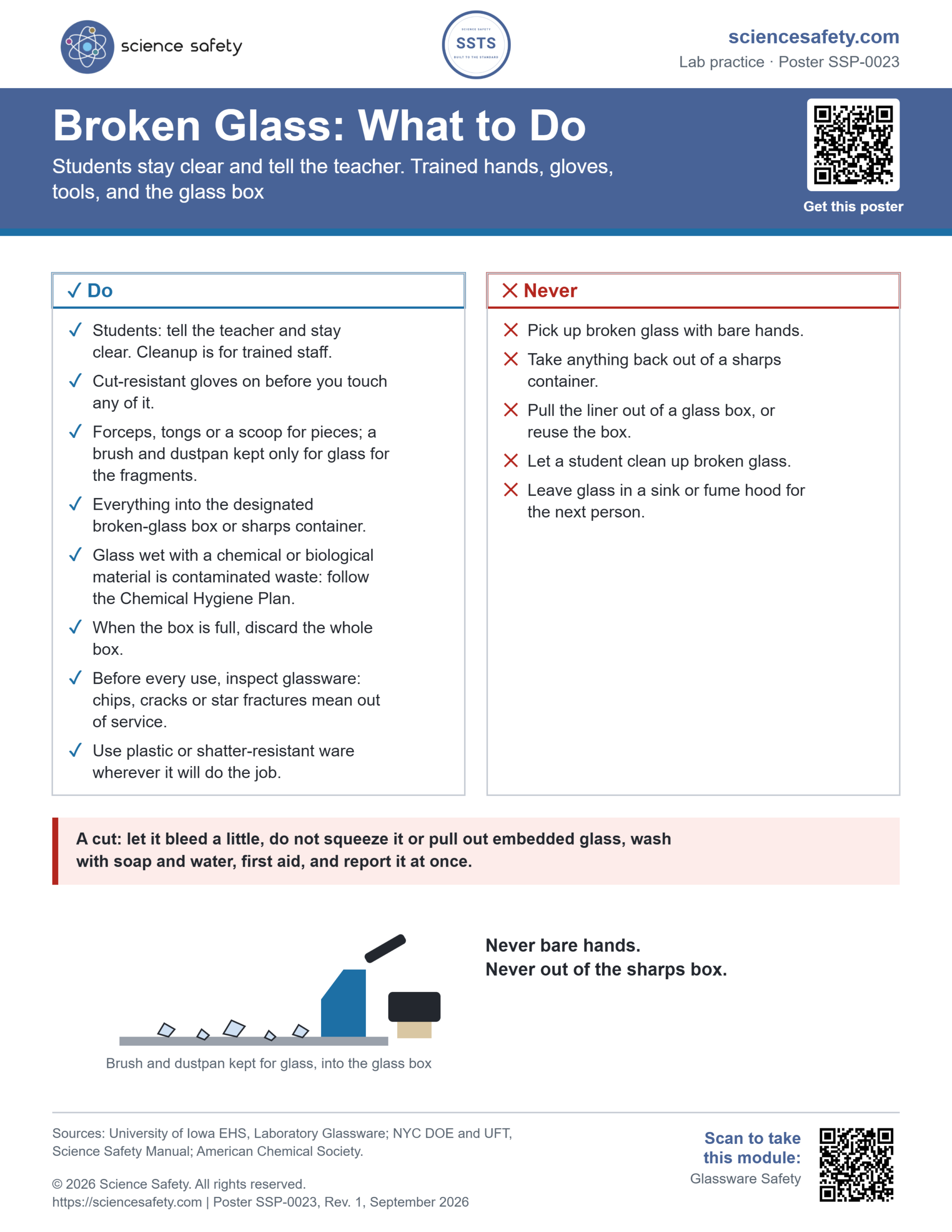
Hang this poster beside the broken-glass box, so the Do and Never lists are in front of whoever reaches for the dustpan.
What is on the poster
Do
- Students: tell the teacher and stay clear. Cleanup is for trained staff.
- Cut-resistant gloves on before you touch any of it.
- Forceps, tongs or a scoop for pieces; a brush and dustpan kept only for glass for the fragments.
- Everything into the designated broken-glass box or sharps container.
- Glass wet with a chemical or biological material is contaminated waste: follow the Chemical Hygiene Plan.
- When the box is full, discard the whole box.
- Before every use, inspect glassware: chips, cracks or star fractures mean out of service.
- Use plastic or shatter-resistant ware wherever it will do the job.
Never
- Pick up broken glass with bare hands.
- Take anything back out of a sharps container.
- Pull the liner out of a glass box, or reuse the box.
- Let a student clean up broken glass.
- Leave glass in a sink or fume hood for the next person.
A cut: let it bleed a little, do not squeeze it or pull out embedded glass, wash with soap and water, first aid, and report it at once.
Built to the Science Safety Teaching Standard
This poster carries the SSTS mark. Like every Science Safety course, it is built to the Science Safety Teaching Standard (SSTS): every rule on it is taken from the body that governs it, at its current edition, and the source is printed on the poster, so you can check it yourself.
Stay current
When you get this poster, it is saved to your Science Safety account. If we revise the poster, or the Glassware Safety module it comes from changes, we will email you, and the latest version will be waiting under Downloads in your account. Every revision carries its revision number and date at the bottom of the poster, so you can tell at a glance whether the copy on your wall is current.
Printing and hanging
- One-page PDF, US letter (8.5 by 11 inches).
- White background, so it prints clearly on any office or classroom printer without using much ink.
- Hang it beside the broken-glass box, at eye level.
- The QR code in the blue title band opens this page, so anyone can get their own copy.
- The QR code at the bottom opens the Glassware Safety module.
Learn more
The Glassware Safety module teaches the full topic this poster comes from.
Sources:
- Laboratory Glassware – University of Iowa Environmental Health and Safety (reviewed September 30, 2026)
- Science Safety Manual – New York City Department of Education and United Federation of Teachers (reviewed September 30, 2026)
- Safety in Academic Chemistry Laboratories – American Chemical Society (reviewed September 30, 2026)
Poster SSP-0023, Rev. 1, September 2026.