
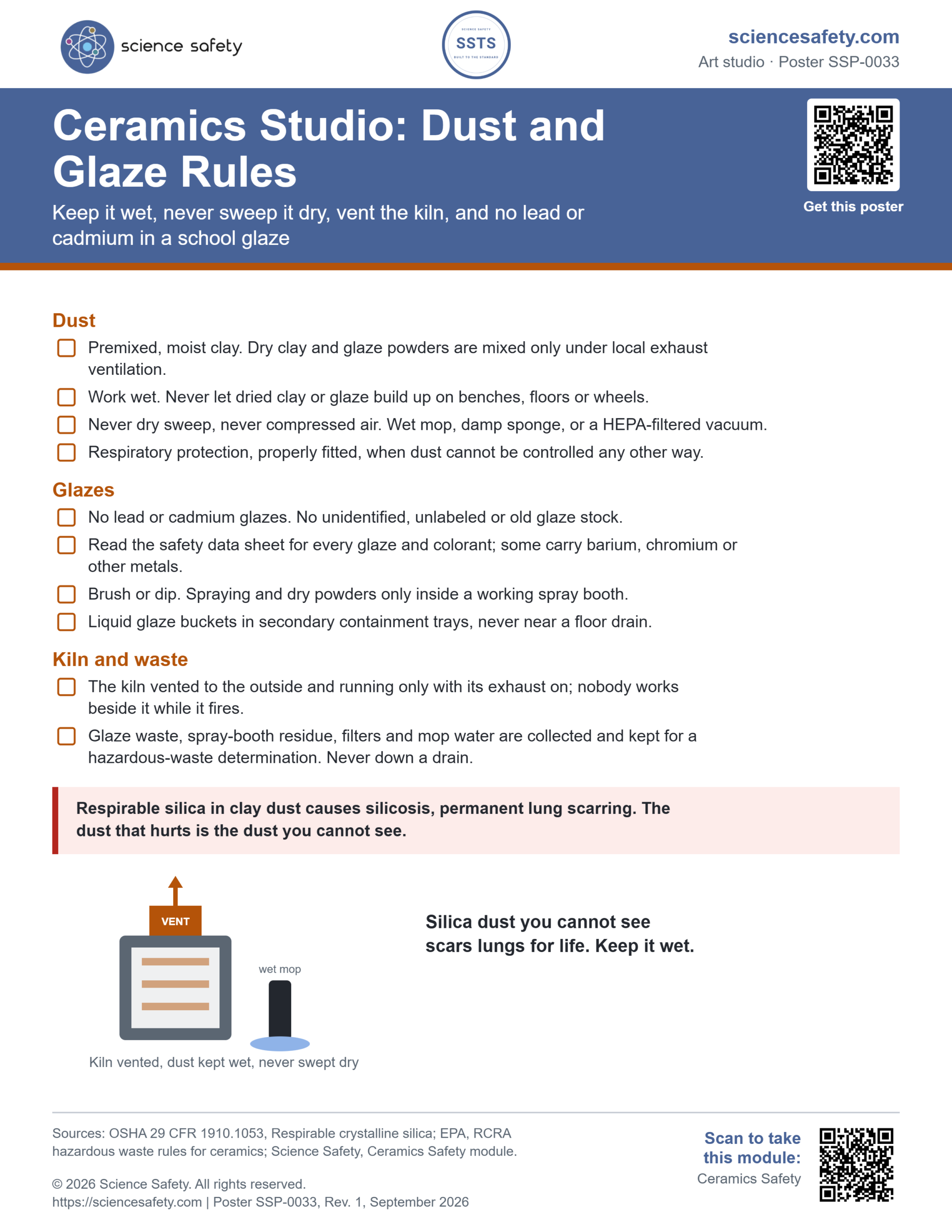
Hang this poster by the clay bins and the glaze bench, so the rules are in front of whoever is working wet or dry.
What is on the poster
Dust
- Premixed, moist clay. Dry clay and glaze powders are mixed only under local exhaust ventilation.
- Work wet. Never let dried clay or glaze build up on benches, floors or wheels.
- Never dry sweep, never compressed air. Wet mop, damp sponge, or a HEPA-filtered vacuum.
- Respiratory protection, properly fitted, when dust cannot be controlled any other way.
Glazes
- No lead or cadmium glazes. No unidentified, unlabeled or old glaze stock.
- Read the safety data sheet for every glaze and colorant; some carry barium, chromium or other metals.
- Brush or dip. Spraying and dry powders only inside a working spray booth.
- Liquid glaze buckets in secondary containment trays, never near a floor drain.
Kiln and waste
- The kiln vented to the outside and running only with its exhaust on; nobody works beside it while it fires.
- Glaze waste, spray-booth residue, filters and mop water are collected and kept for a hazardous-waste determination. Never down a drain.
Respirable silica in clay dust causes silicosis, permanent lung scarring. The dust that hurts is the dust you cannot see.
Built to the Science Safety Teaching Standard
This poster carries the SSTS mark. Like every Science Safety course, it is built to the Science Safety Teaching Standard (SSTS): every rule on it is taken from the body that governs it, at its current edition, and the source is printed on the poster, so you can check it yourself.
Stay current
When you get this poster, it is saved to your Science Safety account. If we revise the poster, or the Ceramics Safety module it comes from changes, we will email you, and the latest version will be waiting under Downloads in your account. Every revision carries its revision number and date at the bottom of the poster, so you can tell at a glance whether the copy on your wall is current.
Printing and hanging
- One-page PDF, US letter (8.5 by 11 inches).
- White background, so it prints clearly on any office or classroom printer without using much ink.
- Hang it by the clay bins and the glaze bench, at eye level.
- The QR code in the blue title band opens this page, so anyone can get their own copy.
- The QR code at the bottom opens the Ceramics Safety module.
Learn more
The Ceramics Safety module teaches the full topic this poster comes from.
Sources:
- 29 CFR 1910.1053, Respirable crystalline silica – Occupational Safety and Health Administration (reviewed September 30, 2026)
- Hazardous waste rules under the Resource Conservation and Recovery Act – U.S. Environmental Protection Agency (reviewed September 30, 2026)
- Ceramics Safety module – Science Safety (reviewed September 30, 2026)
Poster SSP-0033, Rev. 1, September 2026.