
Career Technical Education (CTE) Safety Month highlights the critical role of safety training in career and technical education programs, where students learn real-world skills using real-world tools, equipment, and environments.
Across the country, CTE classrooms are some of the most dynamic learning spaces in education. Students are welding, cooking, building, designing, fabricating, and creating. These hands-on experiences prepare learners for high-demand careers—but they also introduce authentic hazards that must be managed through intentional, role-specific safety training.
Career and Technical Education Month is the perfect time to recognize that high-quality CTE programs are not just innovative—they are safe by design.
The Reality of Risk in CTE Classrooms
Unlike traditional academic classrooms, CTE environments mirror industry settings:
- Woodshops with saws, jointers, and planers
- Metal shops with welding equipment and cutting tools
- Culinary labs with open flames and commercial appliances
- Art rooms with chemicals, kilns, and sharp instruments
- Construction and engineering labs with power tools and machinery
Each of these spaces contains inherent physical, chemical, electrical, thermal, and ergonomic hazards.
Research shows that a significant percentage of STEM and CTE educators have never received formal safety training, a gap that increases the likelihood of accidents and raises legal and duty-of-care concerns for school systems.
Safety, therefore, is not an add-on.
It is the foundation that enables innovation.
Safety Is a Workforce Readiness Skill
In industry, safety is not optional—it is a core professional competency.
Students entering careers in:
- Advanced manufacturing
- Skilled trades
- Health sciences
- Culinary arts
- Engineering and design
are expected to understand:
- Risk assessment
- Proper PPE use
- Hazard identification
- Equipment operating procedures
- Emergency response protocols
When safety is embedded into CTE instruction, students are not only protected—they are more employable.
They graduate with:
- Verifiable safety credentials
- A safety-first mindset
- Industry-aligned habits and behaviors
That is workforce readiness.
A Systemic Approach to Safer CTE Programs
Modern CTE safety is no longer a one-time orientation at the beginning of the semester. It is:
- Continuous
- Role-specific
- Grade-appropriate
- Verifiable
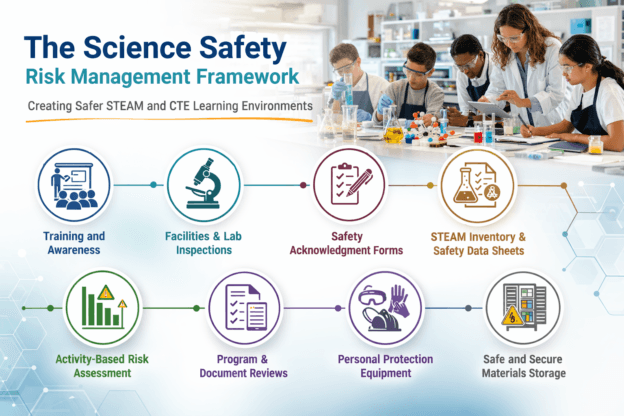
Science Safety’s Safer Platform was built around this exact model, offering over 250 safety courses, modules, and pathways designed for education and industry to create a culture of continuous safety.
This structure allows districts to move from fragmented training to a systemic safety program that serves:
From Individual Modules to Full CTE Safety Pathways
Schools can implement:
Individual Safety Modules
Targeted training for specific tools, hazards, or instructional environments, such as:
These are ideal for:
- Just-in-time training
- Equipment onboarding
- Refresher certifications
Comprehensive CTE Safety Pathways
Structured, certificate-based learning experiences that build a full safety culture for:
These pathways provide a comprehensive understanding of hazards, safer operating procedures, and program-wide safety leadership.
Safer Spaces Across Every CTE Discipline
CTE safety is not limited to industrial labs.
A true safety program reaches:
The Art Room
Where students work with:
- Adhesives
- Solvents
- Glazes
- Sharp tools
Safety training ensures proper:
The Woodshop & Construction Lab
Where the focus is on:
The Metal Shop
Where students must understand:
Protecting Students. Supporting Educators. Reducing Liability.
A proactive safety program does more than prevent injuries.
It:
- Helps districts meet regulatory and duty-of-care obligations
- Provides documented, verifiable training records
- Reduces institutional liability
- Builds administrator confidence in program expansion
Most importantly, it supports educators, many of whom enter CTE teaching from industry and may not have received formalized safety pedagogy in their preparation programs.
With structured pathways, safety becomes:
- Easier to implement
- Easier to track
- Easier to sustain
Micro-Credentials That Prove Competency
In today’s credential-driven world, completion matters—but verification matters more.
Science Safety’s model allows learners to earn:
- Micro-credentials
- Pathway certificates
- Verifiable certification numbers
Each credential provides documented proof of safety training, validating that the learner has completed and demonstrated competency in the required knowledge and skills.
That is powerful for:
- Students entering the workforce
- Educators undergoing evaluation
- Districts undergoing audits
CTE Safety Is a Culture, Not a Checklist
The most successful CTE programs do not treat safety as merely a matter of compliance.
They treat it as culture.
A culture where:
- Students model professional behavior
- Educators lead with confidence
- Administrators invest in prevention
- Programs grow sustainably
When safety becomes continuous and visible, it transforms the learning environment.
Students take greater ownership.
Programs gain credibility.
Communities build trust.
Celebrating CTE Month by Investing in Safer Programs
Career and Technical Education Month is about celebrating opportunity.
Opportunity for students to:
- Discover their talents
- Develop technical expertise
- Enter high-skill, high-wage careers
The safest programs are the strongest programs.
By implementing:
- Role-specific CTE safety pathways
- Tool- and lab-specific safety modules
- Verifiable safety credentials
Schools ensure that opportunity and protection go hand in hand.
Because the goal is not just to prepare students for work.
It is to prepare them for safe, successful, and sustainable careers.
Explore Safer CTE Pathways
This CTE Month, take the next step in building a culture of safety across your programs.
Explore the full catalog of Safer CTE safety certification courses, individual modules, and comprehensive pathways designed for students, educators, and leaders.
Safer programs start with intentional training—and the impact lasts a lifetime.