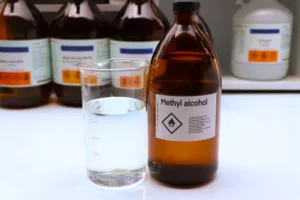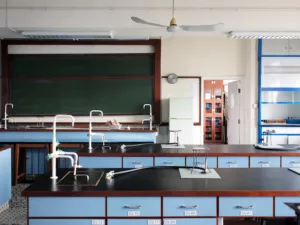
As the calendar year comes to a close, the science department has some necessary safety practices and procedures to ensure that you return to safer instructional spaces (e.g.., laboratories & classrooms) and related areas (chemical storerooms and prep rooms) in January.
Watch this short video first. It is the short list a science and STEAM department works through before the holiday closing: chemical management, housekeeping, plants and animals, and the engineering controls, with two photographs of students at the bench and the faults called out, and the audience questions on crowded labs, training every three years, classroom animals, pre-service safety training and swabbing the school onto agar plates.
Read the video transcript
The calendar year is ending, but the school year is not. Before the building closes for the holidays, the science and STEAM department has a short list of things to do, so that the room you come back to in January is a safer one. Four areas: chemical management, housekeeping, plants and animals, and the engineering controls and safety equipment.
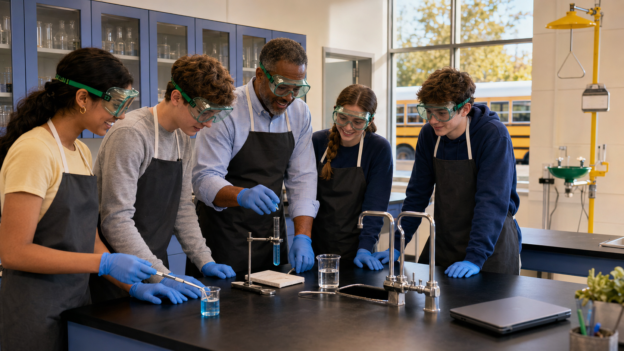
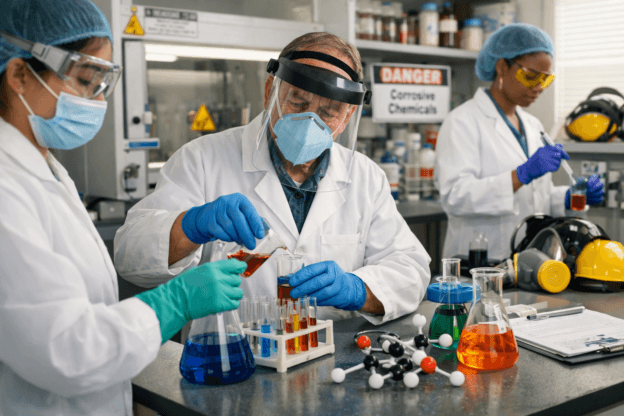
First, look at this, and none of these photographs are staged. Two younger students, the instructors in the background, glassware and chemicals. The first thing that hits the eye is the eye protection, or the lack of it. Safety glasses are fine for physical hazards, springs and projectiles. For liquids that can splash they are almost useless, open at the top and the sides like prescription glasses. Indirectly vented chemical splash goggles seal all the way around. Then gloves, nitrile, and aprons to cover the chest. The student with the longer hair falling forward: pulled back and tied. A spill tray under the work, and a label on what they are using. And this is the most popular elementary STEM image on the internet in 2023, used by publishers and suppliers, promoting the wrong procedure.
Now the secondary level. Look at how close they are. If something splashes or shatters, more than one of them gets it. A lab has safety zones, the same as a shop with power tools; they should not be that close. And the eye protection is wrong again: indirectly vented chemical splash goggles, not safety glasses.
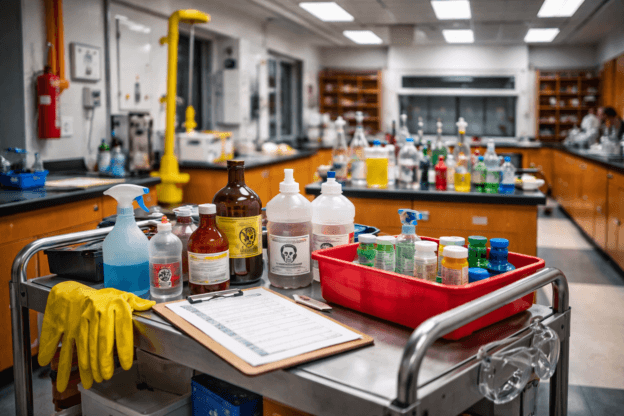
Chemical management first. The inventory must be current, not five years old. Any chemical past its shelf life, any bottle with a broken lid, a failing label or crystals growing at the cap, is dealt with now, through the procedures in your chemical hygiene plan, never left for January. Keep a Safety Data Sheet for every chemical on site, and keep them for thirty years. Return every chemical to its approved storage location. Nothing stays on a cart, a countertop or a floor over the break. Lock the chemical cabinets, the storeroom and the prep room, and give those keys only to staff trained in the laboratory standard. A master key that opens the prep room for every teacher in the building is a liability, not a convenience. Accumulated waste goes out through your plan and your local rules, and when you ask for it to be removed, ask in writing, with your chemical hygiene officer copied.
Housekeeping. Neat and tidy is a daily habit, not a December event. Glassware washed and back in its cabinet, broken glass in a proper broken-glass box, cracked or scored glass thrown out. Nothing stored on the floor. A bottle of acid left on a storeroom floor behind a door has killed a custodian. Anyone who cleans these rooms over the break has had hazard communication training and wears the right protective equipment.
Plants and animals. Animals need food, water, warmth and light every day. If one goes home with a student, get the parent's permission and over-communicate the care instructions. Plants need water, light and a room that is not shut down to fifty degrees. Do not overwater, or you will come back to mold.
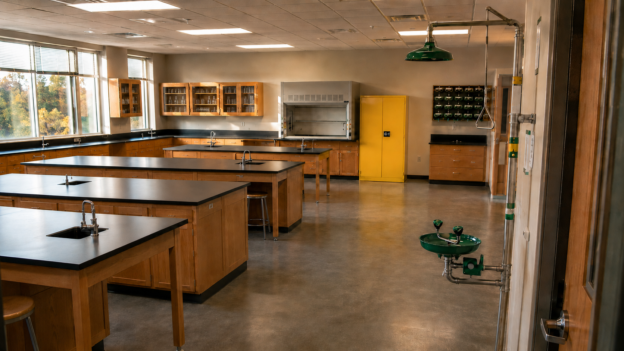
Engineering controls and safety equipment. Walk the room before you leave. The goggle sanitizer lamp is on. Fire extinguishers are charged, tagged and unobstructed, and the fire blanket and sand are there. The master control switches work. The eyewash and the drench shower run clear. Run the eyewash weekly. It is the law. The fume hood is empty, its gas and water valves closed and the sash set. Pour a cup of water into every sink and floor drain so sewer gas cannot come back through a dry trap. Run and empty the dishwasher. Clear the lab refrigerator, and keep food out of it. Anything that fails goes to administration as a written work order, now, not in the new year.
Five questions came in from the audience. First: what do you do with a crowded science laboratory? You decide whether the room is safe, not the principal or the supervisor; in the eyes of the law you have the degree. Find the occupancy load under NFPA 101, the Life Safety Code: fifty square feet net per occupant, usually on the architectural prints from facilities. Over it, or even under it with too much going on, the hands-on work stops and you say so in writing.
Second: I was told to train every three years instead of every year. Is that right? No. Whether you are under federal OSHA, a state plan or the department of labor, the professional practice papers say every year, and training on any change in the plan, the assignment or the chemicals. Every three years is unacceptable, and telling the administration protects them too.
Third: what about animals in the classroom? Check with the school nurse first for allergies to plants or animals; one allergy can rule it out. Tell the parents in writing. Decide where the animal lives, who feeds and cleans, what protection students wear to handle it, and what you will do if it dies in the room. Only safer species, nothing from the wild, and the products of animals count too, owl pellets included.
Fourth: is there a movement to put real safety training into pre-service science teacher programs? Slowly. You can still be hired as a science teacher in forty-two states with no formal safety training; only eight require it. And the move to general science licenses, with no physics or chemistry certification, flushes more safety down the drain. In the meantime, the employer is required under OSHA to train you and to give you a safer place to work, and a promise that you will be held harmless is not worth the breath.
Fifth: our students made agar plates and swabbed floors, doorknobs and desks. Any safety risks? Do not do it. You have no idea what you are culturing from a building full of sick people, and then making slides of it exposes everyone in the room. If it has already been done, cover everything in bleach tomorrow morning, fifteen minutes, then dispose of the plates and loops, or autoclave the glass. Show growth with a simulation instead.
One more thing. The teacher decides whether the lab is safe to use, not the administration. If something required is not done, put it in writing and keep a copy. Stay safer, and come back to a safer room in January.
Science Safety presents school closing reminders for science and STEAM programs: a current inventory and expired or damaged chemicals dealt with now; every chemical back in locked storage and who holds the keys; waste out in writing; housekeeping, broken glass and trained custodians; animals and plants over the break; the goggle sanitizer, extinguishers, shutoffs, eyewash, shower, fume hood, drains and refrigerator walked before you leave; two photographs with the faults called out (safety glasses on younger students, loose hair, no gloves or aprons; crowded secondary students in safety glasses); and the audience questions on occupancy load, three-year training, classroom animals, pre-service training and culturing bacteria from the school.
Don’t miss out on valuable information! Enhance your knowledge by checking out our catalog of webinars or visiting the Science Safety YouTube channel.