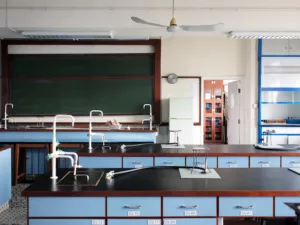
Did you know that teachers with less than three years of experience are recognized risks in the laboratory instructional space?
Watch this short video first. It is what a new science or STEM teacher needs to know: the word safer, what the pictures get wrong, occupancy load, annual training, grade nine, the three-step method before every activity, the engineering controls, and the audience questions on who walks an inspection, chemicals from before GHS, where a supervisor begins, replacing goggles, teacher demonstrations and the right number of chemicals.
Read the video transcript
New teachers are a recognized risk in the science and STEM department. Not because they are careless, but because they are new: no time yet with their students, often no formal safety training, and a room full of hazards they have not learned to see. Here is what a new teacher needs to know, and the first thing is a word. Not safe. Safer. You can never make a lab safe. By following the legal standards and the professional practices, you can make it safer.
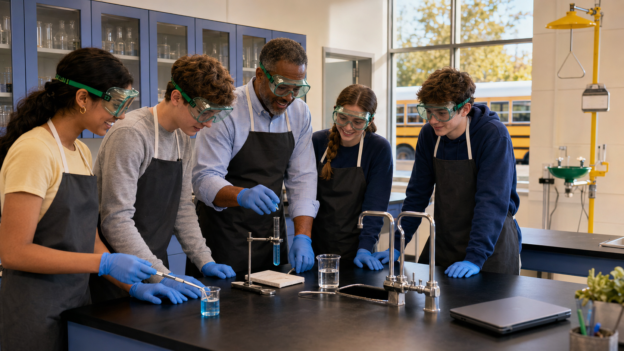
Learn to see what the pictures get wrong. Students bent over beakers in safety glasses: for liquids that can splash, safety glasses are almost useless. Chemical work takes indirectly vented chemical splash goggles, marked Z87.1 D3, not something from the dollar store. Add nitrile gloves, a non-latex apron or a buttoned lab coat, and long hair tied back. And look at the spacing. Students crowded shoulder to shoulder all get the splash when one of them spills.
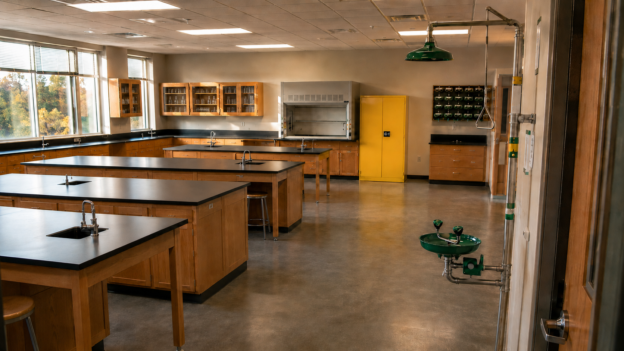
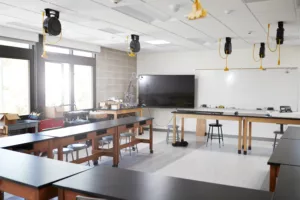
Know your room's occupancy load. The Life Safety Code allows fifty square feet net per occupant in a laboratory, after the furniture and equipment are taken out, two and a half times the space of an ordinary classroom, because of the hazards. If the room is overcrowded, you decide whether it is safe, not the principal. Stop the hands-on work, tell your supervisor, your chemical hygiene officer and your building administrator, and put it in writing.
Training is a legal requirement: every year, when you are hired, when your assignment changes, when the chemical hygiene plan changes and when a new hazardous chemical arrives. More than a third of STEM and CTE teachers have never had formal safety training, and only eight states require it before certification. Teachers who have it have about half the accidents.
And know this number. Seventy percent of school science accidents happen in grade nine. New teachers are usually given grade nine, and grade nine is the first time students meet real hazards. So spend extra time on safety, demonstrate the techniques you expect, model the behavior, use a safety acknowledgment form, and enforce it.
Before any activity, use the three-step method. A hazard analysis from the Safety Data Sheet, your chemical hygiene plan and trusted colleagues. A risk assessment. Then the safety action: engineering controls, administrative controls, protective equipment, or a safer substitute. Review the equipment, the procedure, the waste and the emergency steps. Test-drive a new activity with a colleague before students do it. And ask whether the educational value outweighs the risk. If the voice in your head asks whether this is safe, the answer is no.
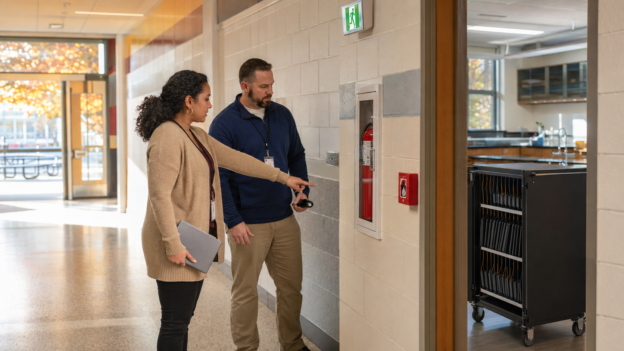
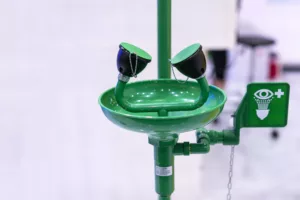
Know your engineering controls and test them. Run the eyewash every week. Never use it for the first time with a chemical in someone's eye. Do not use faulty equipment: a goggle with a vent popped out, a chipped beaker, a sealed container in a microwave. Keep the room tidy, with nothing in front of the extinguisher, the eyewash or the shower. And leave some things out of the program altogether: alcohol burners, bacteria cultured from doorknobs and floors, body fluids.
Questions came in from the audience. First: who is usually involved in a safety inspection of the science department? The chemical hygiene officer, whose responsibility it is; a building administrator, the principal or an assistant; the department chair; and if the problems have been ignored before, a union representative, so somebody else hears what is said and what is not.
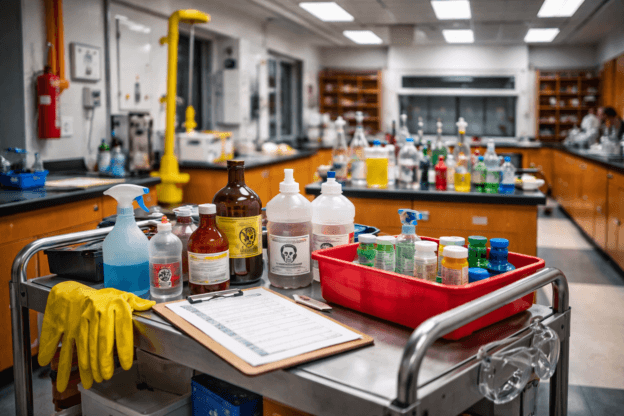
Second: our chemicals predate GHS. Do they need a current Safety Data Sheet and new labels? OSHA grandfathers them: legally the original sheets and labels stand. Better practice updates them, with one caution: a newer sheet may not describe the older chemical exactly. And how long should a chemical stay in the inventory? It depends on the chemical, but in general no more than two or three years.
Third: I am a science supervisor and do not know where to begin with all of this. Is there a checklist? Yes. Start with a needs assessment of what the district has and what is missing, recognize the gaps, and get the people in your building and your district behind fixing them.
Fourth: how often should goggles be replaced? Inspect them every time they come out of the sanitizer. A cracked band, a torn strap, fogging that will not clear, chemical damage: replace them, even a week after buying them. Cleaned with soap and water first, then the sanitizer, and inspected, a pair can last for years.
Fifth: are the safety standards different when the teacher does the demonstration instead of the students? No. Everybody has the protective equipment on, the engineering controls work, and a safety screen stands between the demonstration and the class, with the class in goggles too. What is good for the goose is good for the gander.
Sixth: what is the right number of chemicals for a school inventory? We have more than three hundred. It depends on the curriculum and on the facility. Advanced courses need more. But if the storeroom cannot hold them properly, you do not keep them, and the activities change to fit the room.
You are the one responsible for safety in that room. Trust what you have learned here, ask the veterans, and stay safer.
Science Safety presents safer strategies for new STEM teachers: why new teachers are a recognized risk; safety glasses versus indirectly vented chemical splash goggles; occupancy load at fifty square feet per occupant; training every year and on every change; seventy percent of accidents in grade nine; the hazard analysis, risk assessment and safety action; eyewash, faulty equipment and a tidy room; the activities left out of the program; and the audience questions on who joins a safety inspection, pre-GHS chemicals and how long to keep them, a supervisor's starting checklist, how often to replace goggles, whether teacher demonstrations follow the same standards, and how many chemicals a school should hold.
Don’t miss out on valuable information! Enhance your knowledge by checking out our catalog of webinars or visiting the Science Safety YouTube channel.