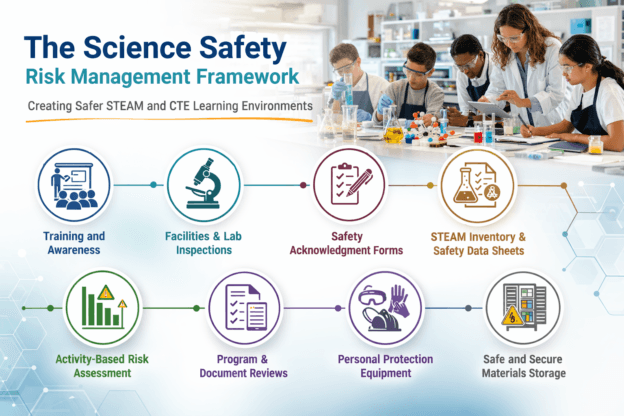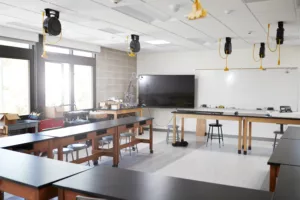
This session is designed to help Science & STEAM educators return to their instructional spaces (e.g.., laboratories and classrooms) and pprepare for a safer new school year.
Watch this short video first. It is how a science and STEAM department opens a safer school year: training, the initial safety assessment, the engineering controls, faulty equipment, the inventory, the three-step method before every activity, seven questions for the year, two photographs of real rooms with the faults called out, and the audience questions on thirty-three students in a lab built for twenty-five and on a district with no safety plan.
Read the video transcript
Safety is a verb. It is something a department does, and the first two months of a school year are when it matters most. Here is how to open safer. Not safe. Safer. You cannot make a laboratory safe. By following the legal standards and the professional practices, you make it safer.
Tell me what you see here. None of these photographs are staged. A power strip on the floor: an electrical hazard and a trip hazard in one, tangle a foot, fall, hit your head, get a shock. On the right, ring stand rods at eye and chest height: potential impalement. An acid bottle out on the bench. And a bottle of drain cleaner sitting on top of the flammable liquids cabinet, with crystals growing on it. If you teach earth science you may love crystals; these do not belong there. This did not happen overnight, and nobody who inspected this room allowed it to continue.
Start with training. Under the laboratory standard, every science educator is trained every year, on hire, on a new assignment, and when new hazardous chemicals arrive. A fifteen-minute online video with three questions is not that training. More than a third of STEM and CTE teachers have had none, and the teachers who have it have half the accidents.
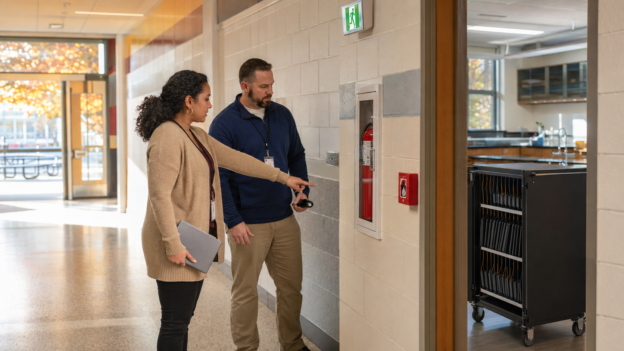
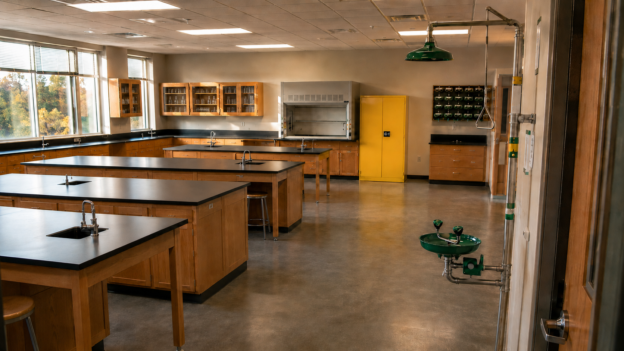
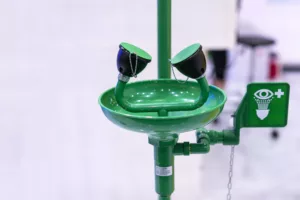
Then an initial safety assessment of the department, before students do hands-on work. Walk every instructional space with the chemical hygiene officer, an administrator and the department chair, and check four things. That everyone is trained. That the engineering controls work: ventilation, eyewash, shower, master shutoffs, and a ground-fault interrupter on every receptacle. That the administrative protocols are in place, with the chemical hygiene plan reviewed over the summer. And that the protective equipment is there, in sizes that fit every occupant. Where something is missing, hands-on activity stops until it is fixed. No ventilation, no lab.
Know the controls. The goggle sanitizer's lamp is checked every year, because a dead bulb sanitizes nothing. An eyewash is plumbed into the water supply, never a bottle on the wall. Ventilation runs continuously and is never recycled to the rest of the building, the filters are changed four or five times a year, and the windows stay shut so the system can do its job.
Look at the growth in this photograph, especially the bottles on the bottom shelf. Residue oozing off the containers and pooling on the shelf. That residue comes from different sources, and the sources do not necessarily get along with each other. It can be a fire. Never in your lab.
Equipment that is faulty is not used. A goggle with a vent popped out is replaced that minute, not at the end of the period. Chipped glassware is thrown out. If a reasonable person would not run the activity with that equipment, neither does the teacher.
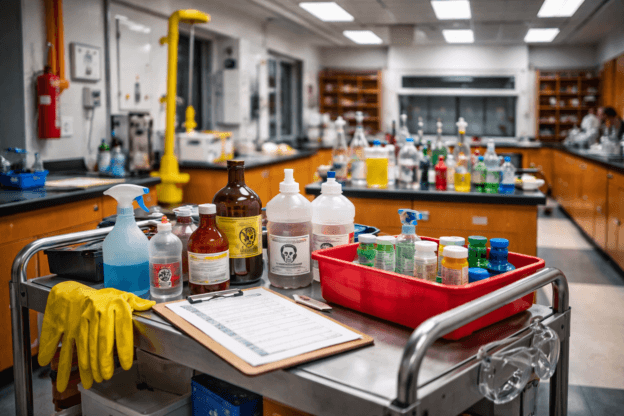
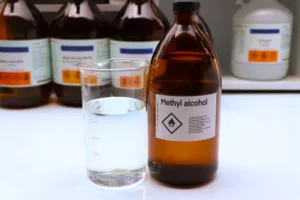
The inventory is current, with a Safety Data Sheet for every chemical, kept for thirty years. Most chemicals should not sit on a shelf more than two or three years, and waste is labeled and scheduled for pickup. Signs mark the eyewash, the shower, the extinguisher, the spill kit and the shutoffs, and the hazard diamond is on the door of every storeroom and prep room so firefighters know what is inside.
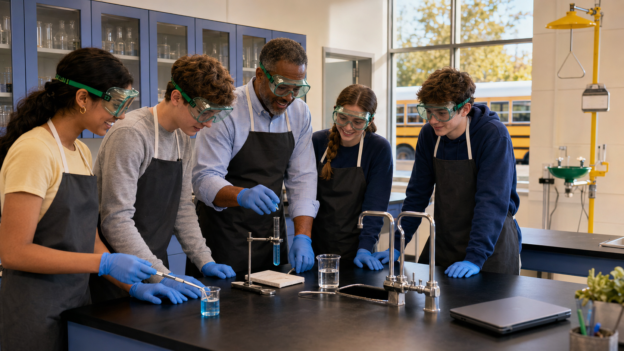
Before every activity, the three-step method: hazard analysis, risk assessment, safety action. Review the sheet, the equipment, the procedure, the waste and the emergency steps. Test-drive a new activity with a colleague. Substitute the less hazardous chemical. The same rules apply when the teacher demonstrates: everyone in protective equipment, and a safety screen between the demonstration and the class. If the risk outweighs the educational value, do something else.
Seven questions decide how safer your year will be. A current chemical hygiene plan. Annual training. Annual inspections. Student safety acknowledgment forms. Enough protective equipment. A current inventory. And whether you are comfortable being personally accountable for the program you have. Where the answer is no, tell your administration, in writing, and keep a copy at home.
Two questions came in from the audience. First: I have just found out that in August I will have thirty-three students in my science ten class. What do I do? Check the occupancy load of your laboratory: fifty square feet net per occupant, teacher and aides included. Length times width, subtract every desk, bench and cabinet, divide by fifty, or ask the fire marshal, who has already set it. If the room is built for twenty-five and they give you thirty-three, tell the administration and guidance in writing that you cannot do hands-on work over the load. The room can still be used as a classroom; a classroom is twenty square feet net. No lab work.
Second: I coordinate secondary science in a district with no safety plan at all. Where do I begin? Find out whether you are under federal or state OSHA, print the OSHA laboratory standard, and hand it to the administration: it lists their responsibilities, your training, the chemical hygiene officer, all of it. Add the NFPA 101 Life Safety Code and NFPA 45. If they ignore it, invite the fire marshal in, and have your union invite an OSHA inspector. Then bring in help to build the program.
Safety is a verb. Stay safer.
Science Safety presents science and STEAM safety protocols for a safer school year: annual training; the initial safety assessment walked with the chemical hygiene officer, an administrator and the department chair; goggle sanitizers, plumbed eyewashes and continuous ventilation; faulty equipment out of use; the inventory and Safety Data Sheets; the hazard diamond on the storeroom door; the hazard analysis, risk assessment and safety action; two photographs with the faults called out (a power strip on the floor, impalement rods, an acid bottle on the bench, drain cleaner with crystals on a flammables cabinet; residue oozing across a storage shelf); seven questions for the year; and the audience questions on occupancy load with thirty-three students and on starting a safety program from nothing.
Don’t miss out on valuable information! Enhance your knowledge by checking out our catalog of webinars or visiting the Science Safety YouTube channel.