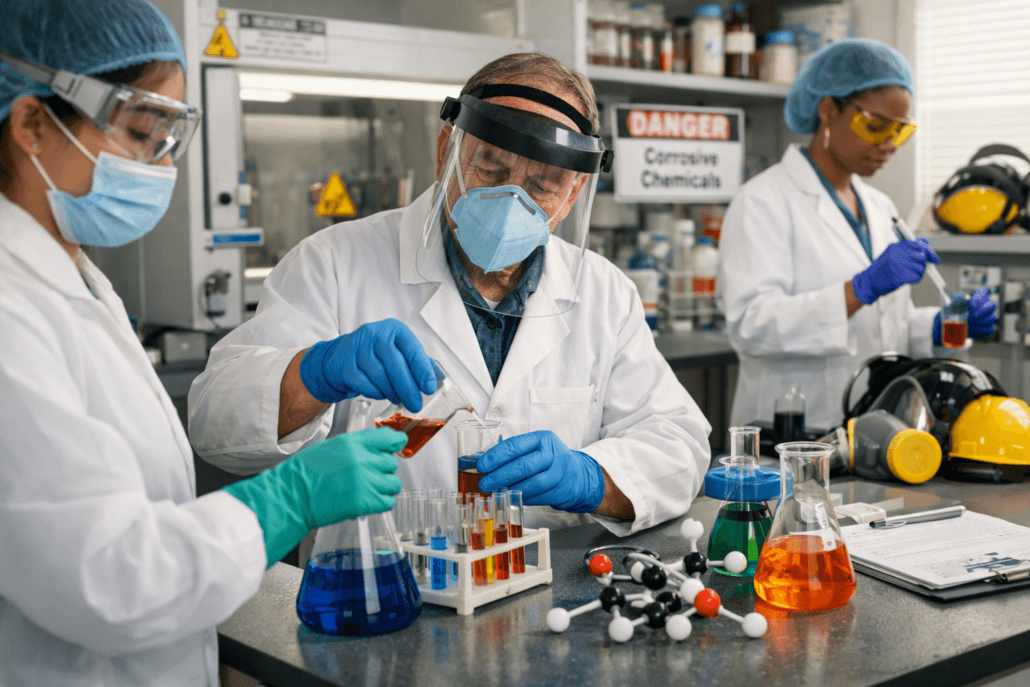
Personal Protective Equipment (PPE) in science labs is not just a compliance requirement. It is a frontline defense that protects students, instructors, technicians, and researchers from preventable injury and long-term harm. Whether the setting is a middle school classroom or an industrial chemical facility, the principles remain the same: identify the hazard, assess the risk, and protect the person.
For lab managers, science instructors, and safety consultants, PPE is both a technical requirement and a cultural marker. When it is implemented correctly, it signals that safety is not an afterthought. It is part of the work itself.
What PPE Really Means in a Lab
The Occupational Safety and Health Administration (OSHA) defines PPE as specialized clothing or equipment worn to minimize exposure to hazards that can cause serious injury or illness. These hazards may be chemical, biological, radiological, physical, or mechanical.
The Centers for Disease Control and Prevention and its division, the National Institute for Occupational Safety and Health, emphasize that PPE is part of a broader hierarchy of controls. It is not the first line of defense. Engineering controls and safe procedures come first. PPE is what stands between the hazard and the human when other controls cannot eliminate the risk entirely.
In practical terms, PPE in a science or CTE lab often includes:
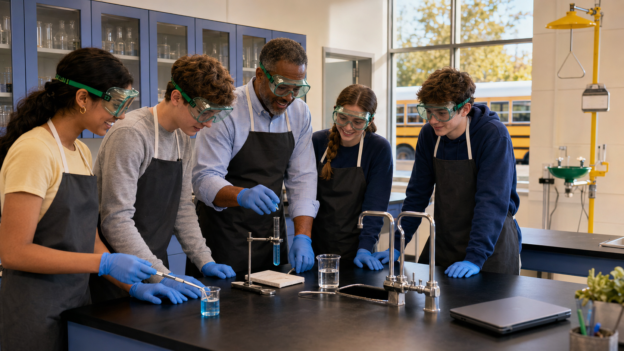
Safety goggles or face shields
Lab coats or chemical-resistant aprons
Gloves appropriate to the chemical or task
Closed-toe shoes
Respiratory protection in specialized settings
But equipment alone does not ensure safety; proper selection, training, maintenance, and enforcement do.
Middle School Science Labs: Building Habits Early
In a middle school classroom, the risks may seem limited. Small-scale reactions. Diluted acids. Basic heating. Yet injuries at this level often stem from complacency.
A splash of dilute acid can still damage eyes. A shattered beaker can still cause deep lacerations. A Bunsen burner can still ignite loose sleeves or hair.
At this level, PPE serves two critical purposes.
First, it prevents immediate injury. Safety goggles are non-negotiable when chemicals or heat are involved. Lab aprons protect clothing and skin. Clear rules about tied-back hair and closed-toe shoes reduce fire and breakage risks.
Second, and just as important, PPE builds lifelong habits. Students who learn that goggles go on before materials are touched carry that expectation into high school labs, university research spaces, and industrial workplaces. They internalize that science requires discipline.
For instructors, consistency is everything. If goggles are “optional” during demonstrations, students will treat them as optional during labs. If a teacher models PPE use every time, even during quick tasks, the message becomes clear: safety is part of doing science.
High School and CTE Labs: Increased Complexity, Increased Risk
In Career and Technical Education labs, hazards expand. Students may work with stronger chemicals, compressed gases, woodworking tools, metal fabrication equipment, or electrical systems.
The risk profile shifts from minor irritation to potentially life-altering injury.
Chemical-resistant gloves must match the specific substances they are used with. Not all gloves protect against all chemicals. Nitrile may be suitable for many solvents, but not all. Face shields may be required during grinding operations. Flame-resistant lab coats may be appropriate where flammable solvents are present.
Instructors and lab managers must conduct formal hazard assessments. OSHA requires employers to assess the workplace to determine whether hazards exist that require PPE. While schools may not always fall under the same enforcement structures as private industry, the standard of care remains the same.
Documentation matters. Written hazard assessments, PPE selection rationale, and training records demonstrate due diligence. They also protect institutions legally and ethically.
Training must go beyond “wear this.” Students need to understand why. Explain how sodium hydroxide can cause deep chemical burns. Show how flying metal fragments travel at high speed. When learners grasp the mechanism of injury, compliance improves.
Industrial and Research Laboratories: High-Stakes Environments
In industrial and advanced research labs, the consequences of failure are magnified. Concentrated acids, carcinogens, biohazards, pressurized systems, and high-energy equipment introduce serious risk.
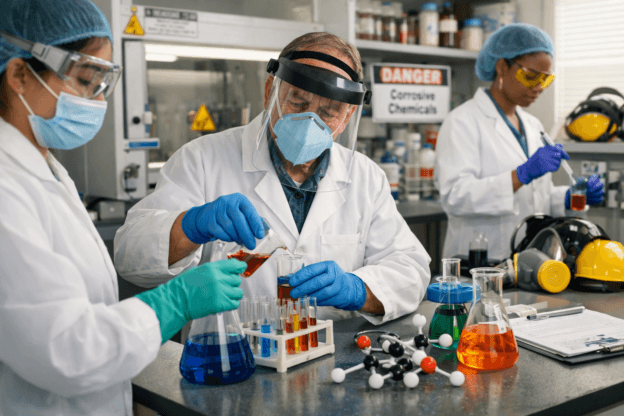
In these environments, PPE is layered. A researcher may wear a lab coat, chemical-resistant gloves, splash goggles, and a face shield simultaneously. Respiratory protection may require fit testing and medical clearance. Chemical suits may be necessary for certain processes.
OSHA standards require employers not only to provide appropriate PPE but also to ensure proper fit and maintenance. Damaged goggles, degraded gloves, or improperly stored respirators compromise protection.
There is also the issue of long-term exposure. Chronic inhalation of solvents or repeated dermal exposure to hazardous compounds can result in occupational illness years later. PPE helps interrupt that pathway.
Lab managers must ensure that PPE programs include:
Regular evaluation of hazards
Proper storage to prevent contamination
Replacement schedules for aging equipment
Clear policies for noncompliance
The message must be consistent: production, research output, or deadlines never override safety protocols.
The Psychology of PPE Compliance
Even with clear standards, PPE compliance often fails for predictable reasons.
Discomfort. Fogged goggles. Gloves that reduce dexterity. Heat buildup in protective clothing.
These barriers must be addressed proactively. Anti-fog goggles, properly sized gloves, breathable lab coats, and well-ventilated spaces reduce resistance. When PPE is comfortable and fits correctly, compliance improves.
Leadership behavior also shapes culture. When supervisors wear required PPE without exception, staff follow suit. When leaders ignore minor infractions, standards erode.
Safety culture is cumulative. It is built through repeated, visible commitment.
Legal and Ethical Responsibility
OSHA makes it clear that employers are responsible for ensuring the use of appropriate PPE when hazards cannot be otherwise controlled. This includes training workers on when PPE is necessary, which type to use, how to put it on and remove it properly, and how to care for it.
For schools, there is an added ethical dimension. Students are minors placed under institutional supervision. The duty of care is significant. Failure to enforce PPE can lead to preventable injury and long-term consequences.
Beyond compliance, PPE demonstrates professional integrity. It communicates that the institution values people over convenience.
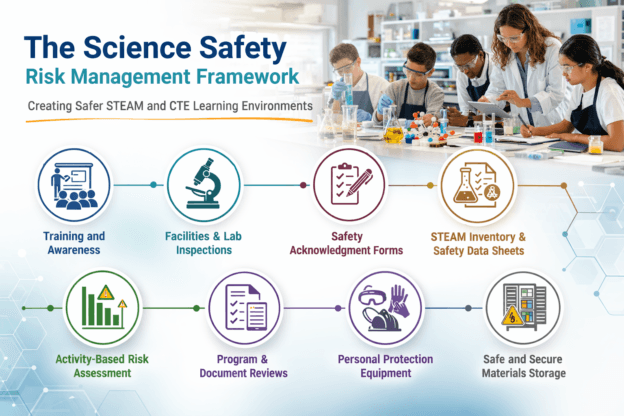
PPE as Part of a Larger Safety System
It is important to remember that PPE is the last line of defense. Fume hoods, machine guards, proper chemical storage, and safe standard operating procedures must come first.
However, even the best-engineered system cannot eliminate every risk. Accidents happen. Human error occurs. Equipment fails.
When that happens, PPE is what stands between a close call and a catastrophic injury.
In a middle school classroom, it may prevent a minor chemical splash from becoming permanent eye damage. In a CTE lab, it may stop a fragment from penetrating the eye. In an industrial research setting, it may prevent toxic exposure that could affect a worker for life.
Personal Protective Equipment in science labs is not simply gear. It is a daily expression of professional responsibility, risk awareness, and respect for human health.
For lab managers, instructors, and safety consultants, the question is not whether PPE is required. The question is whether the culture surrounding it is strong enough to make protection automatic.
When PPE becomes routine, safety becomes sustainable.