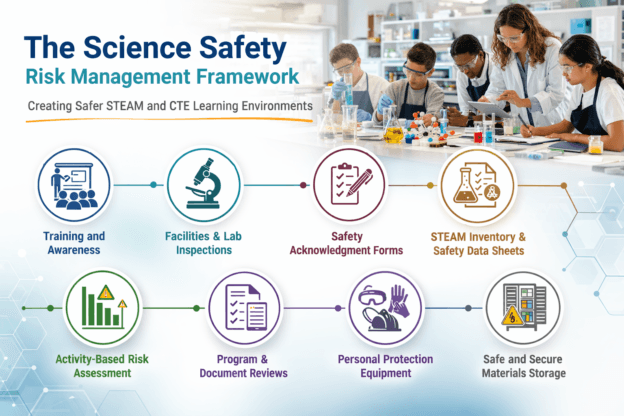
When was the last time a physical safety inspection occurred and was properly documented in your science, STEM, or CTE department at school?
Watch this short video first. It is the once-a-year physical inspection of every science, STEM and CTE space: who walks it, the rule that look is not see, fire, eye and protective equipment checks, fume hoods and shutoffs, chemical storage, seven photographs of real rooms with the faults called out, the written report, and the audience questions on nitric acid compartments, eyewash clearance and prep room door signage.

Read the video transcript
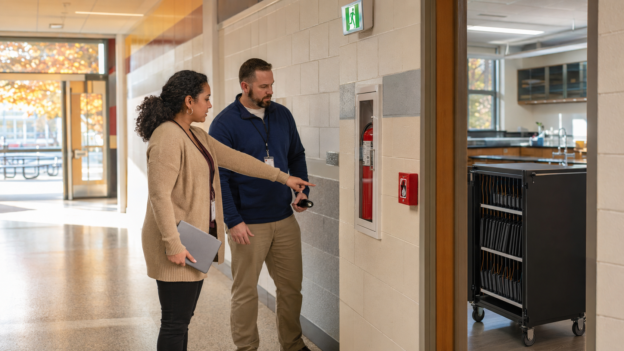
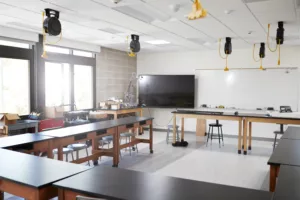
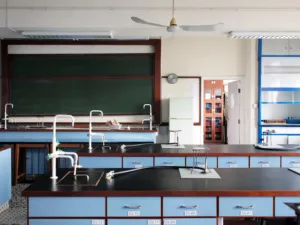
Once a year, every science, STEM and CTE instructional space gets a physical safety inspection. In the flesh, not from a spreadsheet. Not just the labs: the classrooms where demonstrations happen, the prep room, the chemical storeroom. Two people walk it, so there is a witness, and ideally the chemical hygiene officer is one of them. If your district has not named a chemical hygiene officer, OSHA's default is the superintendent. A thorough secondary school inspection takes about four hours.
The first rule: look is not see. Test everything. An eyewash can look fine and have no water flow. An extinguisher can hang on the wall half charged. Six new fume hoods were signed off by the installer's specialist; three of them blew the air into the lab instead of out of it, found only because somebody insisted on switching each one on.
Fire safety. An ABC extinguisher in every lab, classroom and prep room, and in or near the storeroom, mounted on the wall, service tag checked monthly, gauge at full charge. Where combustible metals like sodium or magnesium are used, a Class D extinguisher or Class D powder. Exit procedures posted by the door. And get to know your fire marshal; your local fire code outranks the national one.
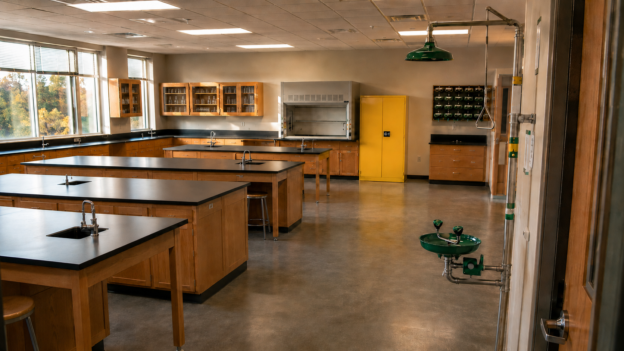
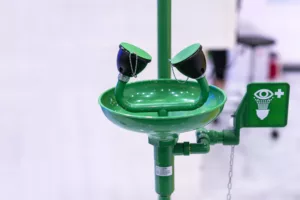
Eye safety. A plumbed eyewash that meets the ANSI Z358.1 standard: fifteen minutes of hands-free flow, tepid water, and thirty-two inches of clear space around it. A squeeze bottle is not an eyewash. It is flushed weekly for two to three minutes, and scale on the nozzles is cleaned off.
Protective equipment. Where liquid chemical or biological hazards are in use, indirectly vented chemical splash goggles marked Z87.1 D3, on every occupant in the room. Safety glasses with side shields only for physical hazards. Nitrile gloves in several sizes, and non-flammable aprons. Protective equipment goes on for setup, stays on for the activity, and stays on for takedown. A middle school student lost an eye on a ring stand rod during takedown, with no eye protection and no instruction to wear it.
Fume hoods draw at least one hundred feet per minute and send nothing back into the building. If you can smell the chemistry lab across the hall, something is wrong, and the request for an inspection goes to facilities in writing. Test the master shutoffs for gas, electricity and water, the drench shower and the eyewash. They are engineering controls only if they work.
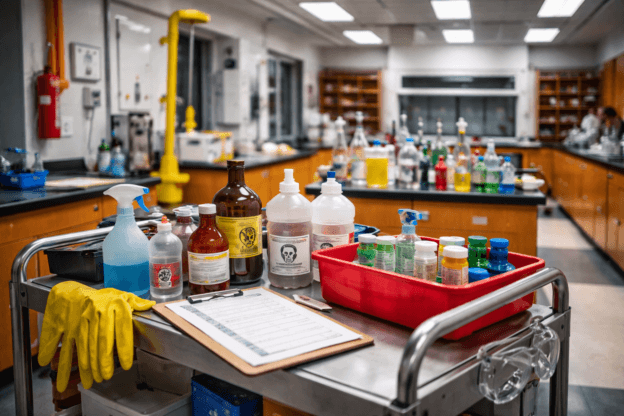
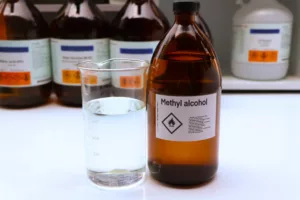
Chemical storage: locked, and segregated by family, with nitric acid isolated from every other acid. White crust on a shelf or an odor at the cabinet door means incompatibles are reacting. Every bottle carries a legible GHS label, every chemical has a Safety Data Sheet, nothing is stored in a food jar, and the inventory is current. Signage: the hazard diamond on every storeroom and prep room door, and approved staff only.
Two photographs from inside a storage cabinet, and nothing here is staged. On the left, look at the crystal growth on that bottle. A fine white precipitate on a bottle or a shelf means an acid and a base are reacting, and if the crust is a peroxide it can be explosive. Some of these labels cannot be read. On the right, look at the rust on the can. The cabinet is there to separate the chemical from the outside world, and something is eating the can from the inside. One day you open that door, and boom.
Now four rooms from one jurisdiction, all real. First, a fume hood. You never store anything inside a fume hood, ever, and this one holds a microscope, hot plates and stirrers, apparatus, and chemicals nobody can name. A bottle of drain cleaner is sitting on the flammable cabinet beside the acid cabinet. Things are on the floor, and the red light on the power strip says all of it is energized. Every bit of this is preventable.
The acid cabinet in that room. The black along the crease and around the frame says acids and bases are reacting inside: formic acid or very old sulfuric acid, with sodium hydroxide or ammonium hydroxide. The white precipitate across the bottom is where the air moves in and out. And the two cabinets are stacked in front of an exit. This did not happen overnight. A fire marshal should have cited it years ago.
The shelves in the same room. There are chemicals dated 1966. Even at ten grams a year, a five-hundred-gram bottle would be gone by now. In the middle, sodium hydroxide has broken through its cap and crusted over. Somebody tried to segregate these and gave up. And the obstructions are against another door.
A prep room. Exercise balls, buckets, foil, boxes, and the pile is against a door. This is not only an emergency problem. Nobody can work safely in it. OSHA caps a fine at about thirty-four thousand dollars per violation, and each of these rooms carries several. If you are a licensed professional and you see it, you fix it, because if somebody gets hurt and you knew, you will not survive the court case.
And the gas cylinders. The red oxygen cylinder is chained to the bookcase, which is right. The green one has no restraint and no valve cover. Knock it over and it is a torpedo through the cinder block. They do have a fire extinguisher.
Then the report goes to the administration in writing, with a copy kept at home. You are the one legally responsible for that space. If it is not safe, no hands-on work until it is fixed.
Three questions came in from the audience. First: what about acid cabinets with a designated nitric acid compartment? OSHA compliance officers accept them, as long as the nitric acid is isolated. One step further: do not open that compartment where it sits. Lift the whole compartment into the fume hood and let the hood run, because the concentrated nitric acid vapors have built up inside it.
Second: where is the thirty-two inch clearance requirement for eyewash stations written? In the ANSI Z358.1 standard for emergency eyewash and shower equipment.
Third: is signage on prep room doors required, and what should it say? Yes. The fire code requires the NFPA hazard diamond on any room where chemicals are stored, including a classroom with a chemical cabinet, so firefighters know what they are walking into. Check with your fire marshal. And it says approved staff only. No students in a prep room or storeroom, ever: one student talks to the teacher while the other pockets the magnesium ribbon, the student is burned, and the teacher is sued for an attractive nuisance. And no master keys for every staff member. Anyone who enters a laboratory must be safety trained, under the OSHA laboratory standard. An English teacher eating lunch in the chemistry lab is a red flag.
Let it be written, and it must be done.
Science Safety presents the annual safety inspection of science instructional spaces: every lab, classroom, prep room and storeroom walked in person by two people; test everything rather than look; ABC and Class D extinguishers; the plumbed eyewash to ANSI Z358.1; goggles, gloves and aprons on for setup, activity and takedown; fume hoods at one hundred feet per minute; chemical storage locked and segregated; photographs of crystal growth and a rusting can in a cabinet, storage inside a fume hood, a blackened acid cabinet stacked in front of an exit, shelves with 1966 chemicals, a prep room piled against a door and an unrestrained gas cylinder; the written report; and the audience questions on nitric acid compartments, eyewash clearance and prep room signage.
Don’t miss out on valuable information! Enhance your knowledge by checking out our catalog of webinars or visiting the Science Safety YouTube channel.