School lab safety begins before students return from summer break. After years of working in and around school laboratories, I have learned not to assume a room is ready simply because everything worked in May. Boxes may block an eyewash station, faucets can sputter, gas tubing can crack, and unlabeled containers may appear in shared preparation rooms. These concerns must be addressed before demonstrations or experiments begin. Reopening a laboratory is not simply cleaning and restocking. It is a deliberate safety process.
Every School Lab Should Have a Chemical Hygiene Plan and CHO
Every school laboratory that uses hazardous chemicals should operate under a written, site-specific Chemical Hygiene Plan and be supported by a designated Chemical Hygiene Officer.
The plan explains how the school manages chemical use, storage, PPE, engineering controls, training, emergencies, and waste. It should reflect the laboratory’s actual chemicals, equipment, and activities—not be a generic document stored in a binder and forgotten.
Under the federal OSHA Laboratory Standard, a Chemical Hygiene Plan and designated CHO are requirements when the work meets the standard’s definition of laboratory use of hazardous chemicals and the employer and employees fall within OSHA’s coverage.
Federal OSHA does not directly cover state and local government employees, including public school employees. Those workers receive OSH Act protections when an OSHA-approved State Plan covers state and local government employment. State Plans must be at least as effective as federal OSHA. Private-school employees are covered by federal OSHA or the applicable State Plan. School leaders should confirm their requirements with the appropriate state occupational safety and health agency.
The federal standard defines the CHO as an employee designated by the employer and qualified by training or experience to help develop and implement the plan. The CHO may coordinate inspections, review inventories and activities, address storage, and support training, but does not carry the safety program alone.
Even where the federal standard does not directly cover a public school, a current Chemical Hygiene Plan and qualified CHO remain essential safety practices.
Begin Before Entering the Storeroom
Before opening the lab, find out what happened during the summer. Was construction or floor work completed? Was ventilation reduced? Did the room experience excessive heat, humidity, water damage, or a power loss? Were chemicals or equipment moved?
Review unresolved work orders, the latest inspection report, chemical inventory, and service records.
At the doorway, pause. An unfamiliar odor, hissing sound, alarm, standing water, visible residue, or damaged chemical container is a reason to stop. Do not enter alone, smell containers, operate electrical switches, or move a leaking or unstable chemical. Restrict access and follow the district’s emergency procedure.
Inspect the Room and Utilities
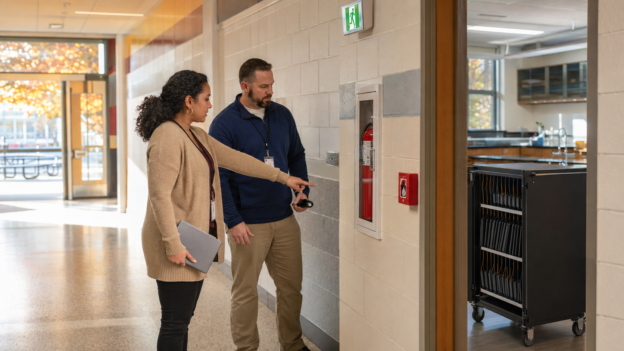
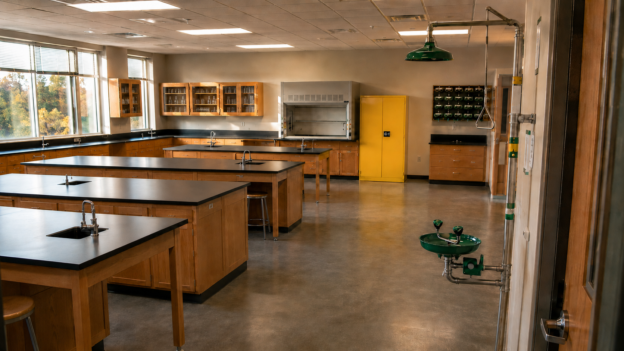
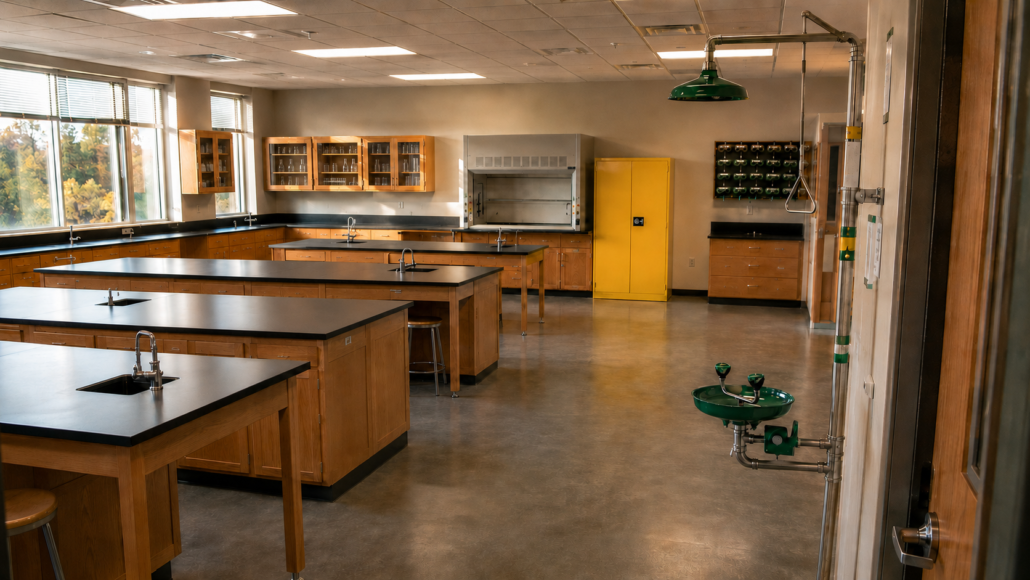
Once the room is cleared for entry, look at it from a student’s perspective. Exits, emergency equipment, and shutoff controls must be unobstructed. Students, including those with mobility needs, must be able to reach an exit or eyewash without navigating around bags, stools, or equipment.
Check sinks, faucets, drains, and hoses. Flush water supplies according to district procedures and report leaks, slow drains, discoloration, or damage.
Gas valves should begin in the off position. Inspect hoses and connections for visible damage, but leave system testing and repairs to qualified personnel. Never test for a gas leak with an open flame. Confirm that master shutoffs are accessible.
Ventilation must be operating as designed before chemicals are opened. Verify that the general system is on its occupied schedule and that the fume hood has a current performance-verification record. The hood should be clear, its sash should move correctly, and its airflow monitor and alarm should function. A fume hood is not a chemical storage cabinet.
Test Emergency Equipment
Emergency equipment must work immediately when needed.
Inspect the eyewash, emergency shower, fire extinguisher, spill-control materials, first-aid supplies, emergency shutoffs, and communication system according to district procedures.
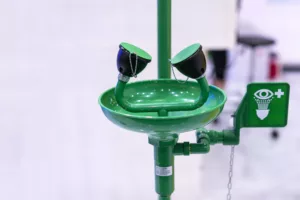
Activate eyewash stations and safety showers on the district’s established schedule. Confirm that nozzle covers release, water flows properly, and the area is clear. Discoloration or inadequate flow requires attention before use.
Fire extinguishers should be visible, unobstructed, and within their inspection period. Do not discharge one simply to test it.
Spill kits should match the room’s chemicals. Check absorbents, neutralizers, disposal materials, instructions, and PPE. A kit is ineffective if no one knows its contents or proper use.
Post emergency numbers, the school address, room number, and reporting procedures where staff can find them quickly.
Review Chemicals Shelf by Shelf
Chemical storage requires more than looking through the storeroom door.
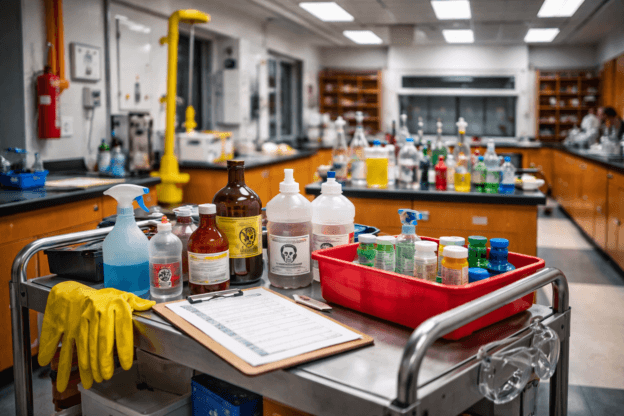
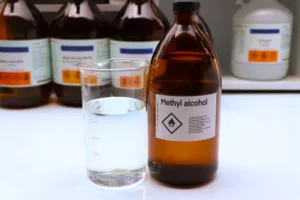
Check each container for a readable label, secure closure, proper location, leakage, corrosion, swelling, residue, or crystallization. Confirm that Safety Data Sheets are accessible.
Some findings require an immediate stop. Do not open, tighten, move, or “test” a container that is bulging, severely corroded, leaking, unidentified, or surrounded by crystals. Secure the area and contact the CHO or the district’s hazardous-materials professional.
Store chemicals by compatibility, not simply alphabetically. Separate acids from bases, oxidizers from flammables and organic materials, and water-reactive chemicals from water sources. Keep heavy containers on lower shelves and use appropriate cabinets and secondary containment.
Chemicals should not be stored permanently in a fume hood, on the floor, above eye level, or in front of safety equipment.
Expired, damaged, unknown, or unwanted chemicals must go through the district’s approved disposal process. Never pour a chemical down the sink or place it in ordinary trash unless an approved procedure specifically permits it.
Update the chemical inventory after the review. An inventory is valuable only when it matches what is actually on the shelves.
Check Equipment and PPE
Inspect laboratory equipment before use. Look for damaged cords, corroded batteries, chemical residue, temperature problems, or failed calibration.
Check glassware for chips, cracks, and residue. Damaged glassware should be removed from service and placed in the designated broken-glass container.
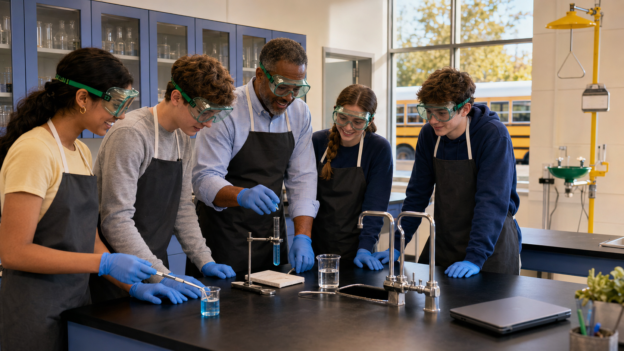
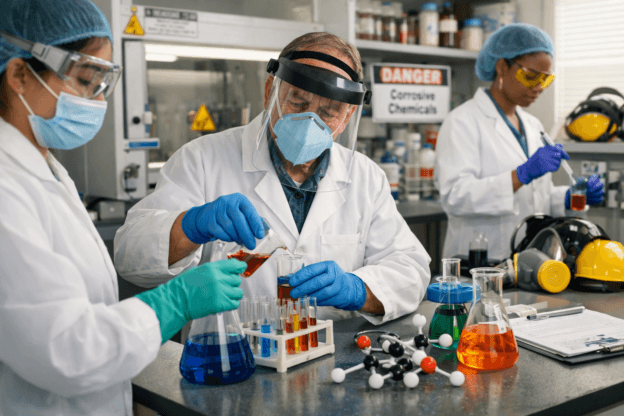
Safety goggles need clean lenses, secure frames, and working straps. Inspect other PPE for damage. Gloves must be selected for the chemical and task; no single glove protects against every substance.
Teachers can document concerns, but specialized repairs, fume hood performance testing, gas testing, and handling unstable chemicals belong to trained and authorized personnel.
Review Safety Protocols Before the First Experiment
A clean and stocked laboratory is not ready until the people using it are prepared.
Safety protocols are extremely important because they turn the Chemical Hygiene Plan into actions teachers and students can follow. Before hands-on work begins, staff should review protocols for PPE, chemical handling, equipment operation, spills, injuries, evacuation, emergency equipment, cleanup, and waste disposal.
Protocols must be written, current, accessible, and specific to the activity. Staff and students need to understand them before an emergency—not encounter them for the first time during one. Any change in chemicals, equipment, room configuration, or procedure should trigger another review.
Students should do more than sign a safety contract. They should locate the eyewash, shower, exits, extinguisher, and emergency shutoffs. They should practice reporting an injury, identify hazard pictograms, select appropriate PPE, and explain where laboratory waste belongs.
Low-preparation activities still require planning. “Save Fred” or a paper-towel investigation may offer a lower-risk way to teach teamwork and variables. Even a baking soda and vinegar reaction requires appropriate quantities, an open container, splash precautions, cleanup procedures, and a hazard assessment.
Fun does not automatically mean safe.
Safety Determines When the Lab Opens
Document each deficiency, the person notified, the work-order number, corrective action, and verification that the problem was resolved.
If the eyewash does not work, the ventilation has not been verified, a gas leak is suspected, or an unstable chemical is present, the affected laboratory work waits. A scheduled experiment is never more important than an unresolved safety concern.
Careful reopening creates the conditions for a safer year of hands-on science.
The laboratory is ready only when the room, equipment, chemicals, procedures, teachers, and students are ready with it.
_________________________________________________________________________
This article provides general educational safety guidance and is not legal advice. Schools should follow their Chemical Hygiene Plan, manufacturer instructions, and applicable federal, state, and local requirements.