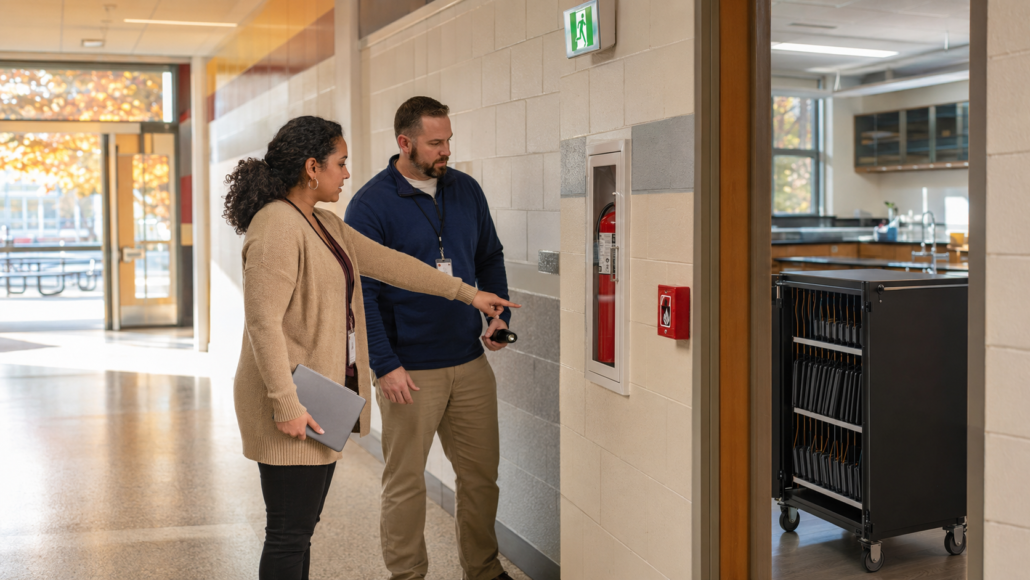
Fire Prevention Month begins with a straightforward question: If the fire alarm sounded right now, would everyone in the school know what to do?
Most schools conduct fire drills, but drills are only one part of fire safety. Prevention also depends on working alarms, clear exits, maintained equipment, safe storage, responsible charging practices, employee training, and students who understand why every alarm must be taken seriously.
The National Fire Protection Association’s Fire Prevention Week will be observed October 4–10, 2026. This year’s theme, “Charge Into Fire Safety: Safe Charging Is a Superpower,” focuses on lithium-ion batteries and the everyday charging decisions that can prevent fires.
That message is especially relevant in schools. Laptops, tablets, cellphones, power tools, robotics kits, cameras, laboratory devices, and other rechargeable products are now used throughout the building. At the same time, familiar fire risks remain in kitchens, classrooms, science laboratories, art rooms, theaters, CTE spaces, offices, mechanical rooms, and storage areas.
Fire prevention requires schools to look at all of them.
Fire Prevention Starts with Everyday Conditions
School buildings have alarms, sprinklers, fire doors, extinguishers, and marked exits, but those protections do not make fires impossible.
An NFPA analysis of school fires estimated that fire departments responded to an average of 3,230 structure fires each year in preschool through grade 12 properties from 2014 through 2018. Those fires caused an annual average of 39 civilian injuries and $37 million in direct property damage.
A fire does not need to destroy a building to have a lasting effect. Even a small incident can expose people to smoke, damage classrooms, force an evacuation, close part of a school, and interrupt learning for days or weeks.
Many fire hazards develop so gradually that they become part of the scenery. One more device is added to a power strip. Boxes are placed in front of an electrical panel. Decorations accumulate near lights or ceilings. A damaged cord remains in use because the equipment still turns on. Supplies begin to fill a mechanical room, and furniture slowly creeps into an exit path.
October is a good time to walk through the building with fresh eyes. Administrators, teachers, facilities personnel, custodians, technology staff, food-service employees, and school safety leaders will notice different things. Looking together can reveal risks that might otherwise be missed.
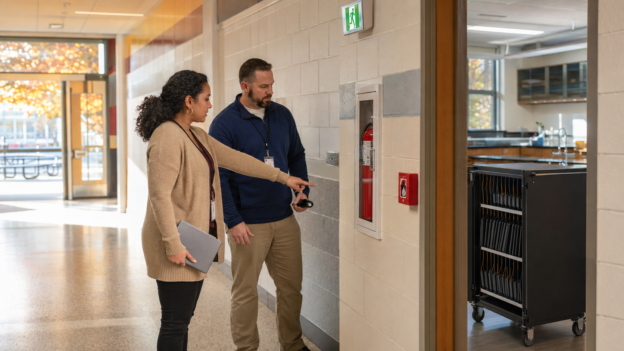
Check whether hallways and exits are clear. Look for fire doors being propped open. Make sure alarms, pull stations, extinguishers, electrical panels, and emergency shutoffs are visible and accessible. Review storage rooms, charging areas, mechanical spaces, and places where heat-producing equipment is used.
The goal is not simply to complete another inspection form. It is to correct conditions that could allow a fire to start or make an evacuation more difficult.
Safe Charging Is Now a School Safety Issue
Lithium-ion batteries are found in nearly every school. They are generally safe when used and charged properly, but a damaged, defective, or overheated battery can catch fire and release heat, smoke, and hazardous gases.
Warning signs may include swelling, leaking, cracking, unusual heat, a strange odor, a change in shape, or hissing and popping sounds. A device showing any of these signs should be removed from use and reported immediately.
Schools can reduce charging risks by following a few consistent practices:
- Use chargers recommended or approved by the manufacturer.
- Charge devices on stable surfaces away from paper, fabric, chemicals, and other materials that can burn.
- Do not overload outlets or connect one extension cord or power strip to another.
- Remove damaged chargers, frayed cords, and cracked plugs from service.
- Never charge a battery that is swollen, leaking, unusually hot, or producing an odor.
- Avoid leaving higher-risk equipment charging unattended or longer than recommended.
- Follow district procedures for isolating and disposing of damaged batteries.
Charging carts and stations also need attention. They should be located where heat can dissipate, cords can be managed safely, and staff can recognize a problem. A cart packed with devices and surrounded by books, paper, or student materials creates unnecessary risk.
If a battery begins smoking, hissing, popping, or rapidly overheating, move people away and activate the school’s emergency procedures. Do not pick up a failing device or place a damaged battery in regular trash.
Higher-Risk Areas Need Specific Attention
Different areas of a school present different hazards, so one set of general rules is not enough.
School kitchens bring together cooking oils, grease, hot surfaces, electrical appliances, and open heat. Exhaust systems and filters require regular cleaning, combustible materials must remain away from cooking equipment, and employees need to understand that water should never be used on a grease fire. Commercial kitchens may require Class K extinguishers designed for cooking oils and fats.
Art rooms, theaters, and CTE spaces may contain kilns, soldering tools, heat guns, hot glue guns, welding equipment, sawdust, paints, finishes, solvents, stage lighting, scenery, and large amounts of stored material. Heat-producing equipment cannot be left operating without appropriate supervision. Flammable products need proper storage, labeling, ventilation, and disposal. Scrap materials and dust should not accumulate near equipment or ignition sources.
Classrooms and offices may appear to be lower-risk spaces, but overloaded outlets, aging appliances, lamps, extension cords, space heaters, decorations, and large amounts of paper can create problems. Extension cords should not become permanent wiring. Decorations cannot cover alarms, exit signs, sprinklers, electrical panels, or emergency information.
Custodial closets, storage rooms, and mechanical areas deserve the same attention. Furnaces, boilers, electrical equipment, cleaning chemicals, paper products, and stored supplies can become a dangerous combination. Mechanical and electrical rooms should never become general storage areas.
Fire Safety in the Science Laboratory
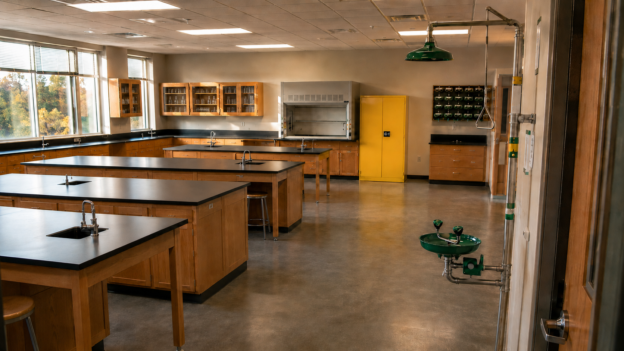
A fire in a science laboratory may be more complicated than a typical classroom fire. Open flames, hot plates, flammable liquids, reactive chemicals, electrical equipment, compressed gases, and combustible metals can cause a small incident to escalate quickly.
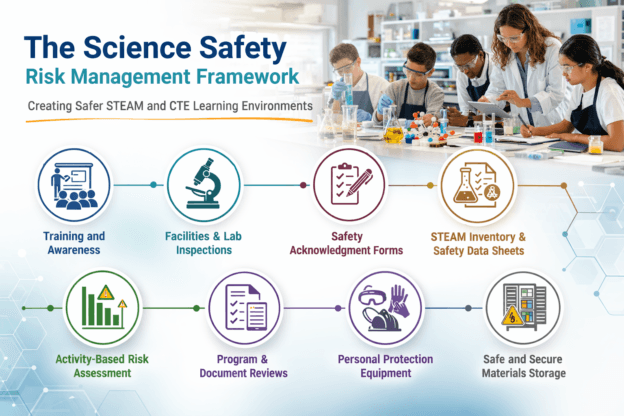
Before beginning any laboratory activity, the teacher needs to evaluate the chemicals, equipment, heat sources, ignition sources, quantities, possible reactions, and emergency response. An experiment or demonstration should not continue simply because it has been used for years. If it cannot be performed safely in the available facility, it needs to be modified or replaced.
Flammable liquids must be kept away from burners, hot plates, sparks, and other ignition sources. Their vapors can move beyond the immediate work area before igniting. Oxidizers must be separated from flammable and combustible materials, and chemicals should be stored according to compatibility—not alphabetically.
Gas hoses, valves, burners, hot plates, electrical cords, and plugs require inspection before use. Defective equipment should be removed from service immediately rather than set aside where someone else may unknowingly use it.
Laboratories using hazardous chemicals also need a current Chemical Hygiene Plan and an appropriately qualified Chemical Hygiene Officer. The plan should address chemical storage, employee training, emergency procedures, incident reporting, and laboratory-specific fire risks while supporting the school’s broader emergency plan.
If someone’s clothing catches fire in the laboratory, the safety shower is the preferred response when it is immediately available. It extinguishes the flames while cooling heated clothing and skin. If the shower cannot be reached, the person should stop, drop, and roll while others call for emergency assistance.
Fire Extinguishers: Know When to Leave
Fire extinguishers are an important part of school fire protection, but having an extinguisher nearby does not mean every employee should attempt to fight a fire.
School policy must be clear. Are employees expected to evacuate immediately, or may designated and trained adults use an extinguisher on a small, beginning-stage fire? Students should never be expected or directed to fight a fire.
The correct extinguisher depends on what is burning:
- Class A: Paper, wood, cloth, and many plastics
- Class B: Flammable liquids and gases
- Class C: Energized electrical equipment
- Class D: Combustible metals
- Class K: Cooking oils and fats
Multipurpose ABC extinguishers are common in schools, but they are not appropriate for every fire. A kitchen may require Class K protection, while a laboratory or CTE space working with combustible metals may need a Class D agent selected for the specific metal. Water must not be used on grease fires, flammable liquids, energized electrical equipment, or water-reactive materials.
Under OSHA’s portable fire extinguisher requirements, extinguishers provided for employee use must be accessible, operable, visually inspected monthly, and receive an annual maintenance check. Employees expected to use them need appropriate education and training.
A trained adult should consider using an extinguisher only when the fire is still small, the correct extinguisher is available, the alarm has been activated, emergency services have been contacted, and a clear exit remains behind the person. Smoke, heat, hazardous vapors, uncertainty about what is burning, or a fire that is spreading are all reasons to leave immediately.
The PASS method—Pull, Aim, Squeeze, and Sweep—provides a helpful reminder, but an acronym is not a substitute for training.
Fire Drills Need to Reflect Real School Conditions
Students usually know the familiar pattern of a fire drill: stop working, line up, leave the building, and wait for permission to return. A useful drill tests more than that routine.
What happens if the usual exit is blocked? Does a substitute teacher know the evacuation route and assembly location? Who accounts for students receiving services in another part of the building? How will the school assist someone with limited mobility, hearing loss, or another need that affects evacuation? Are visitors, volunteers, and after-school groups included in the plan?
Every person must be accounted for at the assembly area. That location should keep students and employees away from the building while leaving room for fire apparatus and emergency personnel. No one should reenter the school until authorized.
Schools also need a plan for an extended evacuation. If the building cannot be reoccupied, where will students go? How will families be contacted? Who manages medications, student reunification, transportation, and accessibility needs?
A drill is successful when it exposes a weakness that can be corrected before a real emergency.
Make October Count
Fire Prevention Month is a chance to bring renewed attention to risks that are easy to overlook during a busy school year.
Use October to inspect the building, review charging practices, remove damaged equipment, organize storage areas, confirm extinguisher maintenance, practice evacuation, and connect with the local fire department. Make sure employees understand their responsibilities and students know that every alarm deserves an immediate response.
Then carry those habits into November and the rest of the school year.
A safer school is built through everyday decisions: keeping an exit clear, storing a chemical correctly, unplugging damaged equipment, supervising a heat source, reporting a problem, and practicing a plan before it is needed. Those decisions may seem small, but together they form the foundation of effective fire prevention.