This webinar on the most common sources of accidents in the K12 laboratory is being facilitated by Science Safety.
Watch this short video first. It is where the injuries in a school lab come from and what prevents them: the 2020 national data, two photographs of students at the bench with the faults called out, the flip-flops in the wood shop, the miter saw zone, the scalpel lesson, the hazard analysis before every activity, and the audience questions on two exits, a district with no chemical hygiene officer, virtual labs after an accident, homework activities, and where a teacher gets real safety training.
Read the video transcript
Eight in ten science and STEM teachers reported an injury in the past year. Here is where those injuries come from, and what prevents them.
The most common sources, from the 2020 national study: glue guns; equipment and machinery; power tools; spills, splashes and chemicals; and projectiles. A spring stretched down a corridor for a wave lesson and let go. A rocket on the soccer field with nobody in eye protection. The injuries that follow are cuts, burns, trips and falls, and electric shock, and ninety percent of them land on the fingers and hands. Some land on the face, for life.
Three kinds of hazard sit in every lab: physical, chemical and biological, and a biology room has all three. Seventy-seven percent of the accidents involve students; the rest involve teachers and aides. Sixty-two percent of teachers name students not following instructions as the leading cause, which is another way of saying the instruction, the modeling and the enforcement came up short. Sixty-nine percent use no safety acknowledgment form. And seventy percent of accidents happen in grade nine: the first formal lab for many students, the heavier courses, the bottom of the pecking order, and usually the newest teacher. Grade nine gets the most safety time, not the least.
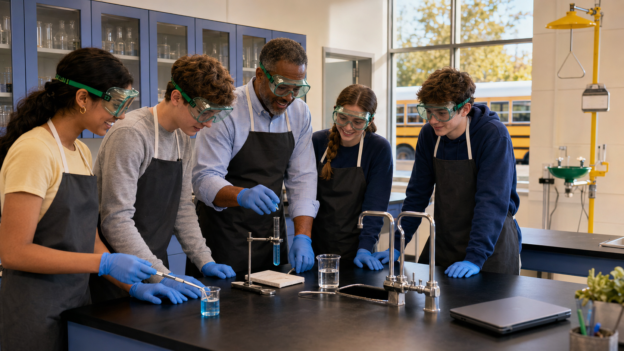
Look at this image from the safety perspective. Before you choose a safety action you name the hazards and the risks, and then you know whether you need ventilation, protective equipment, or both. The first thing that hits the eye is the student in the middle: her hair is hanging down on her shoulder. Bend forward over a burner or a hot plate and gravity takes it into the flame, and she is a torch. It has happened, and the panic takes the whole room. The good news is that they have indirectly vented chemical splash goggles on. Still missing: a non-latex apron over the torso, gloves, and a GHS label on every chemical, unless they are unknowns in a titration. And the teacher read the Safety Data Sheet beforehand, so the protective equipment was known before the class began.
A story that goes with it. A middle school construction lab, the old wood shop: the students had every piece of protective equipment on, shoes included. The teacher came out from behind the desk in flip-flops, with hand tools, power tools, wood and concrete blocks in the room, because regular shoes were uncomfortable. The teacher was cited. The students were fine.
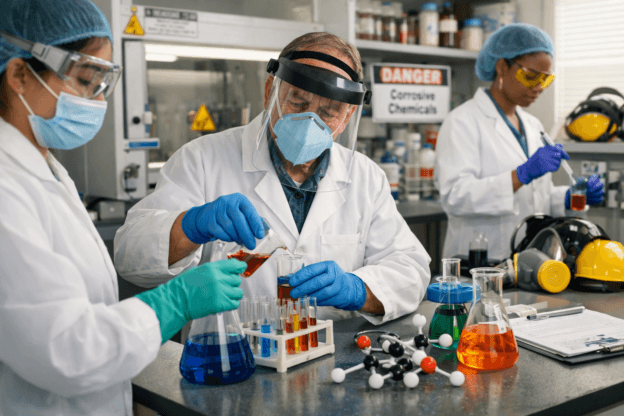
Now this image. Lab coats, very professional. No gloves. And the worst violation is what is over their eyes: safety glasses. Useless in a splash. Even with side shields they are open at the sides and open at the top, and the research shows a splash does get in and can blind. Publishers have learned this the hard way: show an unsafe picture on a cover, somebody copies it, and the publisher shares the liability.
A taped safety zone around a miter saw means one operator inside it and a teacher watching, not two friends crowded in and a teacher's back turned. A sixth grader lost fingers that way.
A seventh-grade teacher handed out scalpels with no safety talk, because the students had surely heard it before. Three were cut, one nearly bled to death, and the court asked why nothing was said. Students forget over a summer. Every activity gets the safety review, every time.
Before each activity and each demonstration: a hazard analysis, a risk assessment, and a safety action, in that order. Engineering controls, then protocols, then protective equipment, and if nothing covers the risk, the activity is not done. If the voice in your head asks whether you should be doing this, the answer is no.
The law and the better professional practices now stand equal in court. A lip on a chemical shelf is a legal requirement in earthquake country and a professional practice everywhere else, and you can be cited for the lack of it either way. The teacher in the room is the one the court holds responsible for safety, ahead of the principal and the superintendent, so concerns go to the administration in writing.
Five questions came in from the audience. First: a laboratory needs two exits. Must they open into a hallway, or may one open into another lab? Exits exist so that everyone gets out alive. From about eight or nine hundred square feet a lab needs two, more as it grows, and the path matters: an exit that leads into the prep room or the chemical storeroom leads toward the danger. Your local fire marshal decides for your room, and you are honest with them about open flames, smoke and ventilation. The same goes for occupancy load: fifty square feet per person is the rule of thumb, and hazardous work can push it lower.
Second: we have four high schools and no chemical hygiene officer. Is that a real job? You have one: by default, OSHA makes the superintendent the chemical hygiene officer, and the superintendent almost certainly does not know it. The department head or the union tells them so in writing and asks for an appointment with the right background. With four high schools, one officer cannot be everywhere; two or three, with release time and compensation, is the realistic shape.
Third: since an injury in our district five years ago, our labs are mostly virtual. Is that a trend, or just us? Start with the accident report, which the district is required to have. Was it investigated, and was training the gap? Most accidents are preventable. Science, technology and engineering are hands-on disciplines; nobody wants a surgeon or a pilot who only trained virtually. Filming labs got schools through the pandemic, and the push now is back to hands-on, inquiry-based work with safety at the front of it.
Fourth, something the speakers added: activities assigned for home. The acknowledgment form is signed by student and parent, the training has happened, and no hazardous material ever goes home, because you assigned it and you are responsible for what happens at the kitchen table.
Fifth: I have taught for seven years. I watched a video and answered five questions when I was hired, and nothing since. Where should a high school science teacher get safety training? A video and five questions is not training. Science Safety exists for exactly this.
Stay safer, and when things are not as they should be, speak up, in writing. In your lab, it falls on you.
Science Safety presents the most common sources of accidents in the K-12 laboratory: glue guns, machinery, power tools, chemicals and projectiles; the 2020 data on who is injured and why; grade nine; two photographs with the faults called out (loose hair over a burner, no apron, no gloves, no labels; lab coats with safety glasses instead of splash goggles); the teacher in flip-flops; the miter saw safety zone; the seventh-grade scalpels; the hazard analysis, risk assessment and safety action; legal standards and professional practices equal in court; and the audience questions on two exits, a district with four high schools and no chemical hygiene officer, virtual labs after an injury, activities sent home, and where to get safety training.
Don’t miss out on valuable information! Enhance your knowledge by checking out our catalog of webinars or visiting the Science Safety YouTube channel.