In this webinar, Science Safety will help you navigate the safety requirements and safer, legal, and professional standards for new teachers across elementary, middle, and high school programs.
Watch this short video first. It is what a new science, STEM or CTE teacher is owed by their employer, what the 2020 national study found, the training that cuts accidents, the yearly program, three photographs with the faults called out, the activities a new teacher does not run, and the six audience questions on the best first step, glasses versus goggles, unreported injuries, grade nine, a smelling storeroom and untrained shop machinery.
Read the video transcript
If you are new to teaching science, STEM or CTE, nobody can make your room safe. You can make it safer, and the way is a program, not a hunch.
Four things your employer owes you before you teach, under OSHA and under the professional practices the courts now treat as equal to law. Safety training, every year, on hire, on a change of assignment, and when the hazardous chemicals change. A current chemical hygiene plan with its standard operating procedures, and a chemical hygiene officer to keep it. Functional engineering controls: ventilation, eyewash, shower and shutoffs, working before the first activity. And a safety manual you have read. If the training has not happened, ask for it in writing, and learn from the professional associations in the meantime, because many preparation programs teach almost none of this.
Take a look at this image from a safety perspective, and nothing here is staged. Glassware, and potentially hazardous chemicals. They have safety glasses on, and safety glasses are useless in a splash. A liquid hazard, or a biological one, needs a border that seals: indirectly vented chemical splash goggles. Hazardous chemicals also mean nitrile gloves, non-latex, and more than likely an apron to cover the rest of the body.
This image, and right away you know from the previous one: safety glasses, useless, cannot help you in a splash. They do have lab coats on, which is a good thing. They do not have gloves, and a caustic liquid on the hand burns. And one more thing: the student in the right-hand corner, her hair is hanging down. Long hair is pulled back behind the neck, because dipped in a caustic chemical or over a Bunsen burner it goes up in flames.
What the 2020 national study of 718 teachers in 42 states found. Twelve percent gave students no safety training before lab work. Eleven percent required no safety test, and a third did not require a perfect score on it. Thirty-five percent of teachers had no formal safety training, and the number is rising with alternative licensure. Thirty-one percent had no Safety Data Sheet system, so a nurse treating a chemical in a student's eye would have nothing to read. Fifty-eight percent could not recall the last annual inspection. Fifty-seven percent had classes above twenty-five, and only twenty-six percent had the floor space for them. Over twenty-four students: forty-eight percent more likely to have an accident. And the single most common cause of injury in STEM and engineering labs was the hot glue gun.
Training that counts is comprehensive: in your preparation program, on hire, and updated within five years. Teachers with all three were forty-nine percent less likely to have an accident. One of the three was not enough.
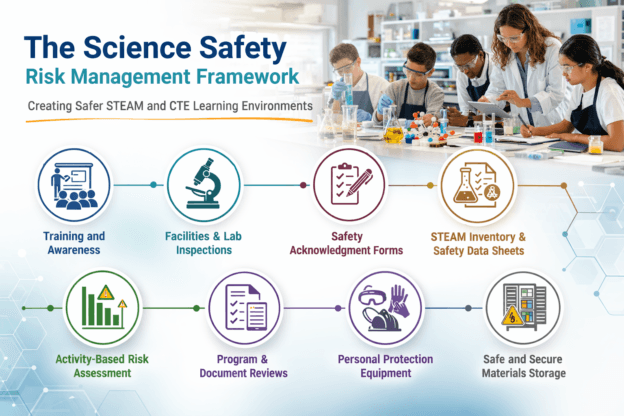
Your program, every year: training; the plan and manual reviewed; a safety acknowledgment form signed by every student after training, and kept at least three years; a hazard analysis, a risk assessment and a safety action for every activity; protective equipment for every person in the room; a current inventory with its Safety Data Sheets, shared with the fire marshal; an annual physical inspection; and chemical storage locked, every time you leave the room, even for two minutes.
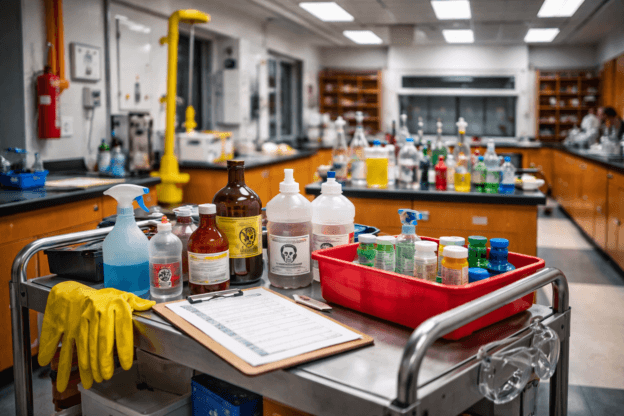
Look at these pictures of chemical storage. The shelves are screaming for help: corrosion, labels you cannot reach or read, chemicals oozing out of their containers. Never have a storage area like this. It is very dangerous.
Some things are not done in a new teacher's room: alcohol burners, live bacteria cultures below advanced biology, body fluids, concentrated flammables and ethers, and formaldehyde. Safety glasses are useless in a splash; liquids need indirectly vented chemical splash goggles, and a principal's assurance that you cannot be sued is false.
Six questions came in from the audience. First: what is the best thing a new STEM teacher can do to be safer? Read the district's chemical hygiene plan and safety plan. Make sure the district trains you early, and ask for it. Then self-educate from the professional associations, because many new science teachers arrive with little or no safety training, and a district does not always pick that up for you. That is how accidents happen.
Second: our labs have safety glasses and goggles. Should the safety glasses go? It depends on the hazard. Physics, where the hazards are physical, uses safety glasses with side shields. Biology and chemistry, with liquid and biological hazards, use indirectly vented chemical splash goggles. Use safety glasses in a chemistry lab and a student is blinded, and you are the one who was supposed to know. If the principal says you cannot be sued, that is false. No activity without the proper equipment: ask for the money and order it.
Third: how many injuries go unreported? There is no central system for reporting accidents in science, STEM or CTE rooms, nothing like a hospital's, and settlements out of court never reach the case law. The 2020 survey was anonymous for that reason, and the teachers were candid.
Fourth: is there a grade to be especially mindful of? Ninth grade, in the research. Perhaps teachers trust high school students with more, perhaps it is maturation. A ninth grader is a very different responsibility from a senior.
Fifth: there is a smell in the storeroom, or something looks old and dangerous. Who does the teacher tell? NFPA 45 requires continuous, unrecycled ventilation in labs, prep rooms and storerooms. Report it to the chemical hygiene officer, your supervisor and the principal, verbally and then in writing. Stop activities that make flammable vapors or toxic fumes until it is fixed; the students come and go, you stay all day. You have the right under OSHA to ask for the air to be tested, and if they refuse, the union.
Sixth: a new CTE teacher has not been trained on the shop machinery and cannot find the manuals. How do they teach the students? They do not, until they are trained. Request training from the district in writing, from its safety officer or a course, on the basic tools students use: the bandsaw, the drill press. And remember that the number one source of injury in the study was the hot glue gun. It is the little things.
Read the plan. Ask for the training. Put concerns in writing. That is how a first year ends safer.
Science Safety presents a holistic safety program for new science, STEM and CTE teachers: the four things an employer owes a new teacher; the 2020 national study of 718 teachers; the three-part training that halves accidents; the yearly program from acknowledgment forms to locked storage; three photographs with the faults called out (safety glasses at a fizzing reaction, lab coats without gloves and loose hair, a corroded and oozing storeroom); the activities a new teacher does not run; and the audience questions on the best first step, replacing safety glasses, unreported injuries, grade nine, a storeroom that smells, and a CTE teacher untrained on the machinery.
Don’t miss out on valuable information! Enhance your knowledge by checking out our catalog of webinars or visiting the Science Safety YouTube channel.