
This webinar on legal liability in K12 districts is being facilitated by Science Safety.
Watch this short video first. It is what a principal, supervisor or superintendent shares in legal exposure for science, STEM and CTE rooms: the hold-harmless myth, duty of care, four real injury cases, the 2020 national data, two photographs of students at the bench with the faults called out, what to require of every teacher and of the district, and the seven audience questions on occupancy codes, chemical lists, training intervals, grade nine, hazard analyses, goggle budgets and old chemicals.
Read the video transcript
If you are a principal, a supervisor or a superintendent, the science, STEM and CTE rooms in your building are a legal exposure you share. Many teachers believe a hold-harmless clause protects them. It does not survive negligence, and it melts away entirely at recklessness: knowing something was unsafe and allowing it anyway. In nearly every lawsuit after a lab injury over the past decade, the supervisor, the principal and the superintendent were named alongside the teacher. The standard the court applies is duty of care: what a careful, prudent parent would have done to protect a student from reasonable, foreseeable harm.
The injuries are not hypothetical. Virginia, 2017: five students burned when a teacher demonstrated with open flame and methanol. Tennessee, 2018: twelve students burned in a flash fire. San Diego, 2019: a thirteen-year-old's face burned by alcohol and flame. Virginia again in 2022: four students burned, no protective equipment, no hazard analysis, and an administration that did not know the activity was happening. Nobody is required to report a lab injury, so most never reach the board. Litigation is what makes them public.
If your district has not named a chemical hygiene officer, OSHA's default is the superintendent, whatever that person's background. Fix that first.
The national data from 2020: fifty-one percent of schools have had an injury that led to litigation. Eighty percent of science and STEM teachers reported an injury in the past year. Thirty-five percent had no formal safety training. Fifty-nine percent of schools do not inventory their chemicals annually, and thirty-seven percent are unsure how they dispose of them. More than half run classes above twenty-five students in rooms designed for twenty-four, and the occupancy load is fire code, not a recommendation. Fifty-five percent of schools do not have goggles that meet the Z87.1 D3 standard. And seventy percent of accidents happen in grade nine.
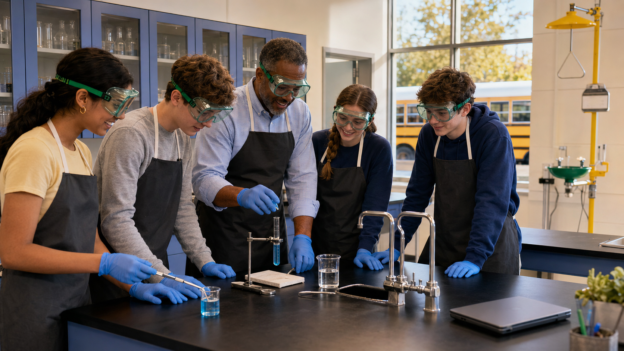
Where do you look for the risk? Take a look at this image. The good news first: look at their eyes. Indirectly vented chemical splash goggles, ten points. But the student in the striped sweater has very long hair on her shoulders, and if she bends over a burner she becomes a lighthouse. Hair is pulled back and tied. They are handling hazardous chemicals with no gloves, nitrile or vinyl. And nothing covers the body. An apron would be a good idea. All of this is required protective equipment.
Now this one, a favorite. They have lab coats, which is a good idea. No gloves. And look at what is over their eyes: safety glasses with side shields. Useless. Open at the top, open underneath, and a splash goes straight in. They need indirectly vented chemical splash goggles. This is a no-go. If you are a supervisor walking past a lab and you see this and do nothing, you have joined the lawsuit.
What you require of every teacher before every activity and every demonstration: a hazard analysis, a risk assessment and a safety action, written into the lesson plan where you can check it. What you require of the district: a safety manual; a chemical hygiene plan reviewed every year, not dated 1991; student safety acknowledgment forms signed by student and parent and kept for your state's limitation period; an annual physical inspection of every lab, prep room and storeroom; safety training every year, on hire, on a change of assignment and when the chemicals change; and an annual chemical clean-out by a licensed contractor.
Questions came in from the audience. First: where are the occupancy standards? NFPA 101, the Life Safety Code, and the occupancy load of a laboratory is fire code, not a recommendation.
Second: is there a recommended and not-recommended list of chemicals for middle and high school labs? There is no national list, and the lists that exist contradict each other. The professional associations publish their own, and the chemical hygiene officer decides for your district.
Third: our district says safety training every three years. Is that acceptable? Absolutely not. OSHA requires retraining whenever the chemical hygiene plan changes, and it is reviewed every year; on a change of assignment, biology one year and chemistry the next; and whenever the chemicals or the activities change. Annual training is the floor.
Fourth: why grade nine? Maturation. Ninth graders are crawling out of their skin, on their phones, not listening, and sometimes handed activities too hazardous for them. Ninth graders carrying agar plates around the cafeteria to culture whatever grows is a no. No culturing bacteria in middle school or grade nine.
Fifth: are new teachers ready to write a hazard analysis on day one? Only if they were trained on day one. Train them when they are hired, then supervise: read their lesson plans and check that the hazard analysis, the risk assessment and the safety action are written in before the activity runs.
Sixth: the principal says the school cannot afford new goggles. Who is liable if someone is hurt? The teacher's answer is that hands-on work stops until the legally required equipment arrives. Go ahead without it and you are the one found reckless, because you knew it was required and did it anyway. The administrator is sued with you.
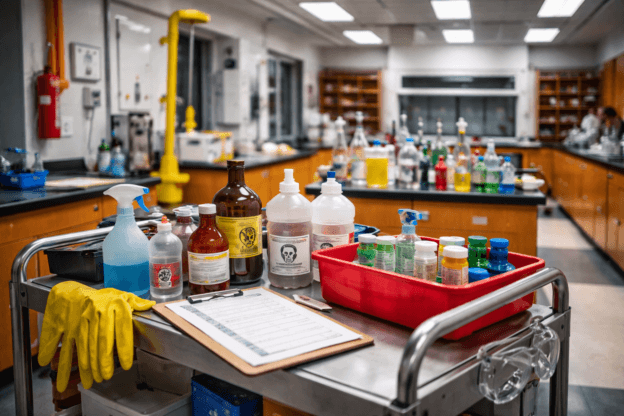
Seventh: a school has had dangerous chemicals for years. How do they get rid of them? A reputable commercial contractor comes in, checks it, packs it and takes it out. The first clean-out after years of neglect costs tens of thousands of dollars; after that, an annual clean-out is a few thousand. And crystals growing on a cap are a peroxide. Nobody touches that bottle. Call the bomb squad. A biology teacher in Maryland opened a peroxide stain with crystals on it, and the explosion took his arm from the elbow down.
Safer is a verb, and in your building, it is yours.
Science Safety presents what school administrators need to know about legal liability in science, STEM and CTE programs: hold-harmless clauses that fail at negligence and recklessness; duty of care; the Virginia, Tennessee and San Diego burn cases; the chemical hygiene officer default; the 2020 data on litigation, injuries, training, inventories, class size and goggles; two photographs of students with the faults called out (long hair at a burner, no gloves, no apron, safety glasses instead of splash goggles); the hazard analysis, risk assessment and safety action in every lesson plan; the district's manual, plan, acknowledgment forms, inspection, training and clean-out; and the audience questions on NFPA 101 occupancy, chemical lists, three-year training, grade nine, new teachers' hazard analyses, the goggle budget and removing old chemicals.
Don’t miss out on valuable information! Enhance your knowledge by checking out our catalog of webinars or visiting the Science Safety YouTube channel.