
Lab safety rules protect students’ eyes, skin and lungs during experiments. The core science safety rules are the same from kindergarten to high school:
- Follow the teacher.
- Protect your eyes.
- Dress for the lab.
- Treat every chemical with care.
- Handle glass, heat and sharp tools slowly.
- Keep food out.
- Report every accident right away.
What changes from grade to grade is how much students do on their own.
Hands-on science is how students learn what a textbook alone cannot show them. A lab also holds chemicals, glass, heat, electricity and sharp tools, so these science lab rules come first. They apply in a science lab, in a classroom with a STEM station or makerspace, and at a kitchen table at home.
Lab safety rules every student should know
- Follow every instruction, written and spoken. If a step is unclear, ask before you start.
- Never work without a teacher in the room, and never try an experiment the teacher has not approved.
- Read the whole activity first, including every caution, before you touch anything.
- Do not touch chemicals or equipment until you are told to.
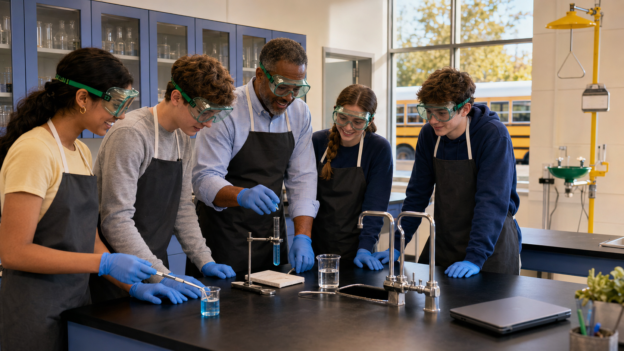
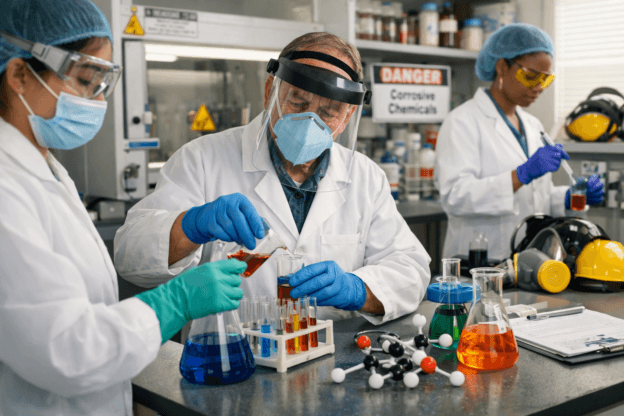
- Wear eye protection whenever chemicals, glassware or heat are used. Everyday glasses are not enough. For liquids, goggles marked Z87 and D3 are made for splashes (NSTA).
- Dress for the lab. The lab clothing rules are below.
- Tell the teacher about any allergy before the lab, including allergies to latex, foods, plants or animals.
- No food, drink or gum in the lab. Never taste anything, never use lab glassware for food or drink, and keep your hands away from your face.
- Keep the workspace and walkways clear. Phones, bags and coats stay off the bench and out of the aisles.
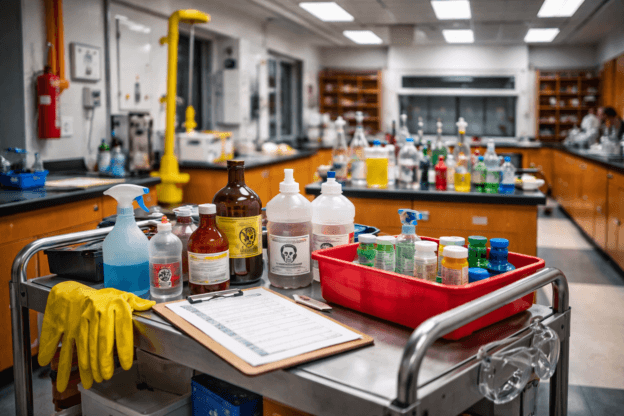
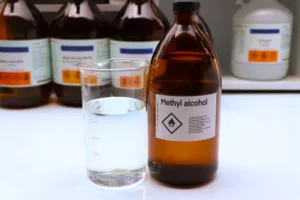
- Read the label twice before using a chemical, and take only the amount you need. Never use anything from an unlabeled container; give it to the teacher.
- Never pour unused chemicals back into the original bottle. Dispose of them the way the teacher tells you.
- Keep chemicals away from your face. Point a test tube away from yourself and others. Smell a chemical only when told to, by wafting the air toward you with your hand.
- Never use your mouth to pipette. Use a bulb or a pump.
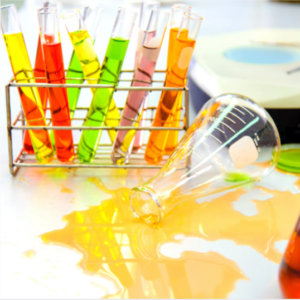
- Check glassware before you use it. Never use a chipped or cracked test tube or beaker. If glass breaks, tell the teacher and do not pick it up with your hands.
- Hot glass and metal look exactly like cold. Give them time to cool, pick them up with tongs or heat-resistant gloves, and turn off burners and hot plates when you finish.
- Carry sharp tools pointed down, cut away from your body, and put them back where they belong as soon as you finish.
- Keep water away from cords and electrical equipment. Do not plug in or unplug anything without permission, and report a frayed cord.
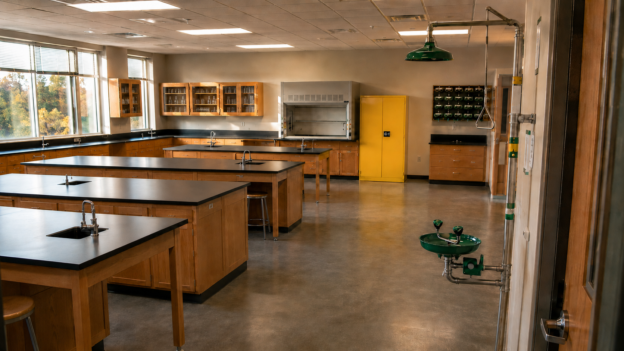
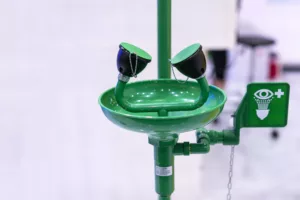
- Report every accident at once, however small: a spill, a cut, a burn or a splash. No running, pushing or pranks, ever. Know where the eyewash, safety shower, fire extinguisher and exits are, and wash your hands with soap and water before you leave.
Lab clothing rules: what to wear
Wear closed-toe shoes, because sandals leave feet open to spills and dropped glass. Tie long hair back, roll up or secure loose sleeves, and take off dangling jewelry. Wear an apron or lab coat when the teacher says so, and gloves when the activity calls for them, for example for dissection. The Connecticut State Department of Education lists the same dress rules in its school lab safety checklist.
Science safety rules by grade level
Lab safety for kids in elementary school
Young students learn the habits that every later rule builds on. An adult handles anything hot, sharp or hazardous, and students keep their hands down until they are told to begin. Goggles go on for anything that can splash or fly, even baking soda and vinegar. Students never taste or smell anything unless told to, and they wash their hands after handling soil, plants or animals. Teachers can find age-appropriate training on our elementary school safety training page.
Lab safety rules for middle school
Middle school brings the first real chemicals, hot plates and glassware. Students now read labels themselves, measure their own amounts and clean their own stations. Many schools ask each student and a parent to sign a safety acknowledgment form at the start of the year. A signed form shows the rules were taught and understood. See middle school safety training.
Chemistry lab safety rules for high school
Chemistry, biology and physics labs add Bunsen burners, stronger acids and bases, dissection and fume hoods. Students read the Safety Data Sheet (SDS) as well as the label. They use the fume hood when an activity calls for it, and they work at a burner only with the area cleared. Flame tests are done the safe way, never with methanol on an open bench. See high school safety training and the Bunsen Burner Safety poster.
What the teacher does before the first lab
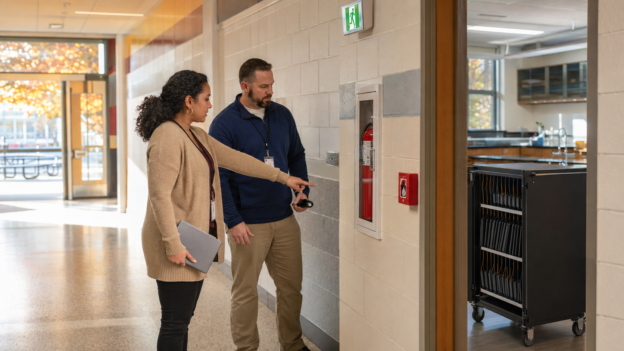
Rules for students work only when the room is ready for them. Before each activity, the teacher:
- checks the hazards and the eye protection the activity needs;
- checks that the eyewash and shower work;
- makes sure the room is not over its safe number of students.
A room with no eyewash is not a room for chemicals or splashes. The teacher also teaches the rules as a routine: shows each one, practices the stop signal and the way out, and goes back over the rules during the year.
Some states write eye protection into law. In Massachusetts, every teacher, student and visitor in a lab using caustic or explosive chemicals, hot liquids or solids, or similar dangerous processes must wear industrial-quality eye protection (Massachusetts General Laws, Chapter 71, Section 55C). Our article on PPE in science labs covers choosing it.
Post the rules where students can see them
A rule on a wall is read every lab, and a rule in a handout is read once. Each of these printable posters covers one part of the rules above:
- Which Eye Protection, When
- Read the Label and the SDS
- Broken Glass: What to Do
- Cords, Plugs and Power Strips in the Lab
- Common Lab Accidents and Their Controls
- Science Activities at Home
The full set is on our science safety and lab safety posters page.
Frequently asked questions
What are the 10 safety rules in a science lab?
- Follow the teacher’s instructions.
- Wear eye protection.
- Dress for the lab.
- No food or drink.
- Read the label.
- Never return chemicals to the bottle.
- Check glassware.
- Handle heat with tongs.
- No horseplay.
- Report every accident.
The full list of lab safety rules above adds eight more.
Do kids need goggles for experiments at home?
Yes, for anything that can splash, spray or fly, including kitchen chemistry like baking soda and vinegar. The Science Activities at Home poster lists the rest.
What should a student do if a chemical gets in the eye?
Go straight to the eyewash and rinse with the eyelids held open for at least 15 minutes, while someone tells the teacher. Do not rub the eye.
Why can’t leftover chemicals go back in the bottle?
One drop of something else can contaminate the whole bottle. The next class would then be using a chemical that is no longer what its label says.
Sources:
- Science Safety – Connecticut State Department of Education (reviewed October 16, 2026)
- Eye Protection and Safer Practices FAQ – National Science Teaching Association (reviewed October 16, 2026)
- General Laws, Chapter 71, Section 55C: Eye protective devices – Massachusetts Legislature (reviewed October 16, 2026)